Important Disclaimer
eBikeGarageHQ provides educational content and estimates only. We are not certified installers, financial advisors, or electricians. Always consult with licensed professionals.
An e-bike’s real range is the distance you’ll actually cover on one charge in the conditions you ride in — not the headline number on the spec sheet. On my own test loop, a 500 Wh pack returns roughly 40–80 km depending on terrain, assist level, temperature and how hard I push the pedals. The single most useful number isn’t the battery’s capacity in watt-hours; it’s how many watt-hours per kilometre (Wh/km) you actually burn.
That gap between marketing range and measured range is the whole reason this site exists. I’ve spent years riding and wrenching across hub-drive and mid-drive bikes through real Swedish seasons, logging energy at the wall and on the same repeatable loop, and the pattern never changes: published range numbers are best-case fiction with no weather asterisk. This guide is the map of how I measure range honestly, and it links out to every deeper piece in the range cluster so you can budget your own ride with the same battery-bench discipline I use on my stationary packs.
What Actually Determines E-Bike Range
Range is just battery energy divided by consumption: usable watt-hours ÷ Wh/km. A 500 Wh battery that you discharge to roughly 90% usable gives about 450 Wh of working energy. Burn 7 Wh/km on a flat commute and that’s ~64 km; burn 18 Wh/km up hills in cold headwind and it collapses to ~25 km. Same battery, very different day.
Four variables move Wh/km more than anything else, and none of them appear on a glossy range claim:
- Terrain and gradient — climbing is by far the biggest energy cost. Flat tarmac is cheap; sustained hills are brutal.
- Assist level and your own pedal input — a higher assist multiplies how much the motor adds to your effort. Pedalling harder yourself is the cheapest range upgrade there is.
- Temperature — lithium cells deliver less usable capacity when cold, and cold air is denser to push through.
- Weight, tyres and wind — total system weight (rider plus cargo), tyre pressure and rolling resistance, and headwind all add up.
The way I make sense of all four is to stop thinking about "how big is the battery" and start thinking about "how many Wh/km will I burn today." That reframe is the foundation of my whole real-world range calculator method, which turns those four variables into a defensible distance estimate.
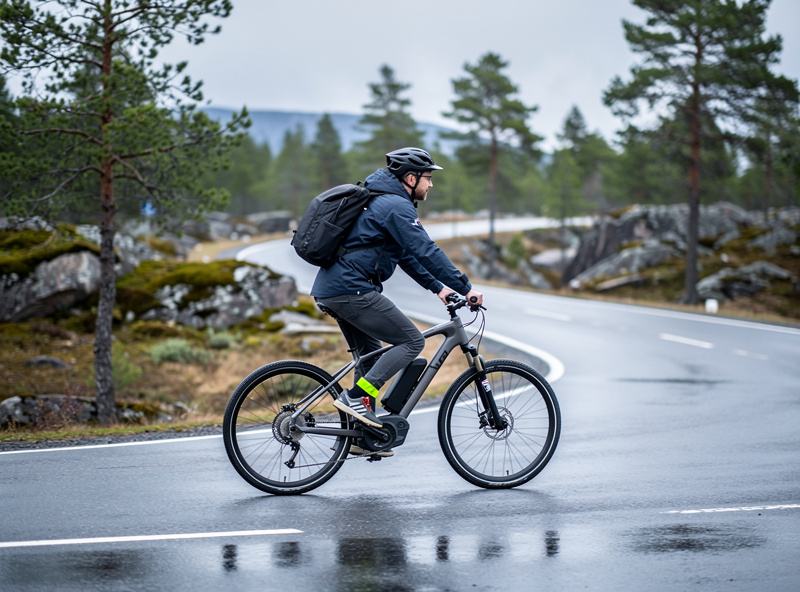
There’s an order of magnitude here worth internalising. Gradient dwarfs almost everything else: a route with 400 m of climbing in 20 km can double your Wh/km versus the same distance on the flat, because lifting rider-plus-bike against gravity is the most expensive thing a motor ever does. Wind comes next — a stiff headwind on an exposed Swedish coast road can add as much load as a gentle hill that never ends. Temperature and tyre pressure are smaller individually but compound: a cold pack on soft tyres into a headwind stacks three penalties at once, which is exactly the January morning that ruins a brochure estimate.
Watt-Hours: The Only Honest Unit
Battery capacity printed in amp-hours (Ah) is nearly useless on its own because it ignores voltage. Watt-hours fix that: Wh = volts × amp-hours. A 36 V 14 Ah pack and a 48 V 10.5 Ah pack are both ~500 Wh and store the same energy, even though the Ah numbers look different. When someone quotes you a battery in Ah without the voltage, they’re hiding the ball.
This is the same maths I run on every stationary pack on my battery bench — Wh doesn’t care whether it’s pushing a wheel or backing up a house. Once you anchor on watt-hours, range becomes arithmetic instead of marketing. The companion piece on Wh per km by terrain breaks down the consumption side of that equation with the actual numbers I log across flat, rolling and steep routes.
Range by Battery Size and Riding Style
The table below is a planning grid I built from my own logged Wh/km figures across riding styles. It assumes ~90% usable capacity and pedal-assist riding (not throttle-only). Treat these as honest mid-range estimates, not promises — your loop, your legs and your weather will shift them.
| Battery (usable) | Easy flat commute (~8 Wh/km) | Mixed rolling (~12 Wh/km) | Hilly / high assist (~18 Wh/km) | Cold + headwind (~22 Wh/km) |
|---|---|---|---|---|
| 360 Wh (~324 usable) | ~40 km | ~27 km | ~18 km | ~15 km |
| 500 Wh (~450 usable) | ~56 km | ~37 km | ~25 km | ~20 km |
| 625 Wh (~562 usable) | ~70 km | ~47 km | ~31 km | ~26 km |
| 750 Wh (~675 usable) | ~84 km | ~56 km | ~38 km | ~31 km |
| 2 × 500 Wh (~900 usable) | ~112 km | ~75 km | ~50 km | ~41 km |
Notice how the worst-case column is barely a third of the best-case for the same battery. That’s the spread the marketing number quietly drops. If your daily route lands in the right-hand columns, size your battery for that column, not the brochure.
A few words on how to read this grid in practice. The Wh/km headers are the figures I actually log, not invented round numbers — ~8 Wh/km is a light, low-assist flat commute with real pedalling; ~12 Wh/km is the honest all-rounder most riders land near; ~18 Wh/km is hills or generous assist; ~22 Wh/km is the cold-and-windy worst case. If you don’t yet know your own number, start by assuming the ~12 column and tighten it once you’ve logged a loop. And remember the table assumes you discharge to roughly 90% usable — running a pack dead flat to squeeze out the last few percent is hard on the cells and gains you very little distance, so I plan to the usable figure and keep a margin. The full method for turning your own four variables into a single trustworthy estimate lives in the real-world range calculator guide.
How Assist Level Changes the Equation
Assist level is the lever most riders never think to pull. On my bikes, dropping from the top assist setting to a middle one on the same loop routinely cuts Wh/km by a third or more, because the motor is multiplying a smaller share of the work. The trade is speed and sweat, not safety. If you arrive with battery to spare every day, you’re carrying assist you don’t need — and range you could have banked.
There’s a real technique to it: low assist on flats where you don’t need the help, saved-up high assist for the climbs where it earns its keep. I break the whole strategy down, with logged before-and-after numbers, in the deep-dive on assist level and battery use. It’s the fastest free range gain available to anyone.
Hub-Drive vs Mid-Drive: Does the Motor Type Change Range?
It does, but less than people assume and not always in the direction they expect. A mid-drive motor pushes through the bike’s gears, so on a climb you can downshift and keep the motor in an efficient cadence range — that’s why a well-ridden mid-drive often returns better Wh/km on hilly terrain than a hub motor straining at low wheel speed. On the flat at steady pace, a simple geared hub motor can be perfectly efficient and the difference narrows to almost nothing.
What actually matters more for range is rider behaviour: a torque-sensing system (which measures how hard you pedal and assists proportionally) tends to sip energy compared with a cadence-sensing system (which dumps a fixed level of assist the moment the pedals turn). I own both kinds, and the torque-sensor bike is consistently the more frugal on my loop because it rewards real pedal input. If you’re choosing a bike for range, the sensor type and your own legs will move the needle further than the motor’s mounting position.
Cold Weather: The Asterisk Nobody Prints
Cold is where manufacturer range claims fall apart hardest. A lithium pack in near-freezing temperatures delivers noticeably less usable capacity than the same pack warm, and you’re simultaneously pushing through denser, colder air, often into winter headwind, on higher rolling resistance from cold tyres. My winter range log shows the practical hit can be substantial — the same commute that’s comfortable in summer can leave the battery far lower in January.
The good news is that most of it is recoverable with habits, not gadgets: storing and charging the battery indoors, fitting it warm at the last moment, and budgeting your distance for the cold column of that table above. I cover exactly what I do through the dark months in cold weather e-bike range loss, written from a Nordic commuter’s bench rather than a spec sheet.
One nuance riders get wrong: the cold doesn’t permanently damage the pack in the way they fear, and the lost capacity largely returns once the cells warm back up. What you’re losing on a winter ride is available energy in that moment, not the battery’s long-term health — provided you’re not charging it ice-cold or storing it on a freezing balcony for months. So the winter game is logistics, not panic: keep the pack indoors at room temperature, carry it inside at both ends of the commute, and treat the cold column as your real planning range from November to March. None of this is a battery-chemistry intervention — it’s the same charge-habit discipline I apply to every cell I own, and I keep it firmly at the habits level, never at the cell-tinkering level.
Range Anxiety Is a Math Problem, Not a Feeling
Most range anxiety dissolves the moment you replace a vague worry with a number. If you know your loop is 30 km, you burn ~12 Wh/km on it, and your usable energy is ~450 Wh, you have a comfortable margin — and you can prove it before you leave. The fear comes from riding blind; the cure is logging one honest loop so the maths is no longer a guess.
That’s the whole psychology of it: the battery gauge lies non-linearly, but the watt-hour budget doesn’t. I walk through how I turned range anxiety into a pre-ride calculation in range anxiety vs range math, including the simple margin I keep so a surprise headwind never strands me.
The reason the gauge feels untrustworthy is that battery voltage doesn’t fall in a straight line as it empties — it sits high for a long while, then drops faster near the bottom, so a four-bar display can lose its last bar quickly and spook you. A watt-hour budget ignores that drama entirely: 450 Wh in, 12 Wh/km out, 37 km available, full stop. Once you’ve ridden a few loops and the maths keeps holding, the anxiety simply stops showing up, because you’ve replaced a wobbling needle with arithmetic you trust. And if you’re tempted to lean on higher assist "just in case," that’s exactly the habit that drains you faster — the assist level guide shows why riding calmer is the real safety margin.
Why Manufacturer Range Claims Read High
Manufacturer range figures aren’t outright lies — they’re best-case lab or eco-mode numbers, usually a light rider on flat ground at the lowest assist in mild weather, sometimes with optimistic assumptions baked in. The number is technically achievable and almost never representative. The fix isn’t outrage; it’s translation: take the claim, assume real-world riding lands well below it, and check it against a measured Wh/km budget.
I put a batch of published claims next to my own logged numbers from the same conditions in manufacturer range claims, tested. The lesson holds across brands: trust the watt-hours and your own loop, treat the brochure as a ceiling you’ll rarely touch.
EU and US Class Rules (and Why They Touch Range)
Legal class shapes range because it caps the speed the motor will assist you to. In the EU, a standard pedal-assist e-bike (an EPAC/pedelec) is limited to 250 W continuous rated power with motor assistance cutting off at 25 km/h; above that you pedal unassisted. That’s the frame I actually ride under in Sweden. In the United States, the common three-class system is different: Class 1 (pedal-assist to 20 mph / ~32 km/h), Class 2 (throttle-assist to 20 mph), and Class 3 (pedal-assist to 28 mph / ~45 km/h).
Why it matters for range: a US Class 3 bike assisting to 45 km/h burns far more Wh/km holding that speed than an EU pedelec capped at 25 km/h, because aerodynamic drag climbs steeply with speed. Faster legal classes trade range for pace. Always confirm your local rules — this is general information about how the classes are defined, not legal advice, and the details vary by country and state.
How to Log Your Own Range (My Method)
You don’t need lab gear to get an honest number — you need one repeatable loop and a little discipline. This is the exact method I use, and it’s the backbone of every figure on this site.
- Pick a fixed loop you ride often, ideally 10–30 km, that includes your typical terrain mix. Same route every time so the only variables are weather and assist.
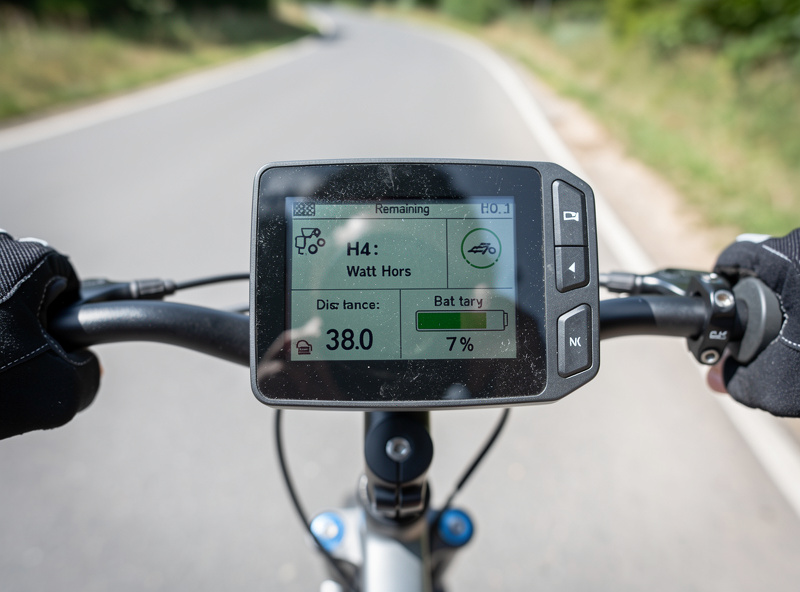
- Start from a known charge. Charge to full, note the date and outdoor temperature. If your display shows watt-hours used, that’s the gold standard; if it only shows percentage, record the percentage drop.
- Ride your normal way — don’t baby it for the test. The point is your real consumption, not a hypermiling record.
- At the end, do the maths: Wh used ÷ km ridden = your Wh/km for that day and those conditions. Log it next to the temperature and the assist level you used.
- Measure the charge at the wall too. A cheap plug-in watt-meter shows how much energy went back in, which tells you your true usable capacity over time — the same wall-logging discipline I run on every pack on my stationary bench.
Do this across a few rides and a couple of seasons and you’ll build a small table of your own Wh/km figures — flat-summer, hilly-summer, cold-winter. That personal table beats any manufacturer claim, because it’s measured on your bike, with your weight, on your roads. The terrain Wh/km guide shows what mine look like as a starting reference.
Practical Ways to Actually Extend Range
Once you’re thinking in watt-hours, the levers are obvious and mostly free. Correct tyre pressure cuts rolling resistance. Lower, smarter assist use saves the biggest chunk. Keeping the battery warm in winter recovers cold losses. Pedalling a real share of the work stretches everything. A second battery or a larger pack buys raw capacity when habits aren’t enough — and the watt-meter discipline I bring from my stationary battery bench applies directly: log your charges at the wall and you’ll know your true usable Wh, not the rated number.
The point of measuring is freedom. When you know your Wh/km and your usable energy, you stop guessing, stop topping up out of fear, and start riding to the actual edge of the battery with a margin you chose. That’s range reality — and every spoke in this cluster is a deeper tool for getting there.
Related Guides in This Cluster
- E-Bike Range Calculator: Real-World Numbers — turn the four variables into a distance estimate.
- E-Bike Wh per km by Terrain — the consumption side, logged across route types.
- Cold Weather E-Bike Range Loss — what a winter log actually shows.
- E-Bike Assist Level and Battery Use — the fastest free range gain.
- Range Anxiety vs Range Math — replace the worry with a number.
- Manufacturer Range Claims, Tested — brochure numbers next to my log.
- Hub Motor vs Mid-Drive: The E-Bike Choice — the motor decision that shapes hills, handling and conversion.
- Hub Motor vs Mid-Drive on Hills — what actually climbs, and why.
- Torque Sensor vs Cadence Sensor — the sensor that shapes how the bike feels on every ride.
- E-Bike Battery Care: The Habits That Make a Pack Last — the full battery-habit cluster.
- Charge to 80% or 100% — the daily charge question, with the answer.
- E-Bike Battery Lifespan: How Many Years to Expect — the realistic 3-6 year window.
- E-Bike Winter Battery Storage — the half-charge rule for Swedish winters.
- E-Bike Charging Cost: The Wall-Outlet Math — the per-charge and per-year arithmetic.
- Conversion Kit Implications: Hub vs Mid-Drive — the donor-bike build, from my own bench.
Frequently Asked Questions
How far can an e-bike go on one charge?
A typical 500 Wh e-bike covers roughly 40 to 80 km per charge in real conditions. The exact distance depends on terrain, assist level, temperature and rider input. Divide usable watt-hours by your logged Wh per km for an honest estimate.
How do I calculate my real e-bike range?
Take usable battery energy (about 90 percent of rated watt-hours) and divide by your measured Wh per km. A 450 Wh usable pack at 12 Wh per km gives about 37 km. Log one repeatable loop to find your real Wh per km.
Why is my real range lower than the advertised range?
Advertised range is a best-case figure: light rider, flat ground, lowest assist, mild weather. Real riding with hills, higher assist, cold or wind burns far more watt-hours per km, so measured range commonly lands well below the brochure number.
Does cold weather reduce e-bike range?
Yes. Cold lithium cells deliver less usable capacity, and you also push through denser cold air, often into winter headwind on higher rolling resistance. Storing and fitting the battery warm recovers much of the loss.
What is the difference between EU and US e-bike rules?
EU pedelecs are limited to 250 W continuous and assist cuts off at 25 km/h. US bikes use a three-class system: Class 1 and 2 assist to 20 mph, Class 3 to 28 mph. Always confirm your local rules.
What is the most effective way to extend e-bike range?
Using lower, smarter assist and pedalling a real share of the work saves the most watt-hours, and it is free. Correct tyre pressure and keeping the battery warm in winter add further range before you consider a larger pack.
Related Guides in This Cluster — Complete Spoke List
Full spoke list of the E-Bike Range cluster:
- “Manufacturer E-Bike Range Claims
- “E-Bike Range Anxiety vs Range Math: Trusting the Numbers”
- “E-Bike Assist Level and Battery Use: Where the Wh Go”
- “Cold Weather E-Bike Range Loss: What a Winter Log Shows”
- “E-Bike Wh per km by Terrain: A Field-Logged Energy Budget”
- “E-Bike Range Calculator: Real-World Numbers
More From This Site
Other guides across e-bike range and the rest of the Ebikegarage library:
- “E-Bike Charging Cost: The Wall-Outlet Math”
- “Charging Habits That Extend E-Bike Battery Life”
- “E-Bike Battery Lifespan: How Many Years to Expect”
- “E-Bike Winter Battery Storage: The Half-Charge Rule”
- “Is a Second E-Bike Battery Worth It? An Honest Take”
- “Charge Your E-Bike Battery to 80 or 100? The Honest Answer”
- “E-Bike Battery Care: The Habits That Make a Pack Last”
- “Conversion Kit Implications: Hub vs Mid-Drive
- “Hub or Mid-Drive for Commuting: Which One to Buy”
- “E-Bike Weight Distribution and Ride Feel: Where the Mass Sits”
- “Hub vs Mid-Drive Maintenance: The Honest Cost of Each”
- “Torque Sensor vs Cadence Sensor: How Each One Feels to Ride”
- “Hub Motor vs Mid-Drive on Hills: What Actually Climbs”
- “Hub Motor vs Mid-Drive: The E-Bike Choice That Actually Matters”
- “Manufacturer E-Bike Range Claims
- “E-Bike Range Anxiety vs Range Math: Trusting the Numbers”
- “E-Bike Assist Level and Battery Use: Where the Wh Go”
- “Cold Weather E-Bike Range Loss: What a Winter Log Shows”
- “E-Bike Wh per km by Terrain: A Field-Logged Energy Budget”
- “E-Bike Range Calculator: Real-World Numbers