Important Disclaimer
eBikeGarageHQ provides educational content and estimates only. We are not certified installers, financial advisors, or electricians. Always consult with licensed professionals.
Charging an e-bike is remarkably cheap. A full charge of a 500 Wh battery pulls a little over 0.5 kWh from the wall after charger losses, so at typical electricity prices it costs only a few cents to perhaps twenty cents, depending on where you live. A year of commuting is a rounding error next to almost any other transport.
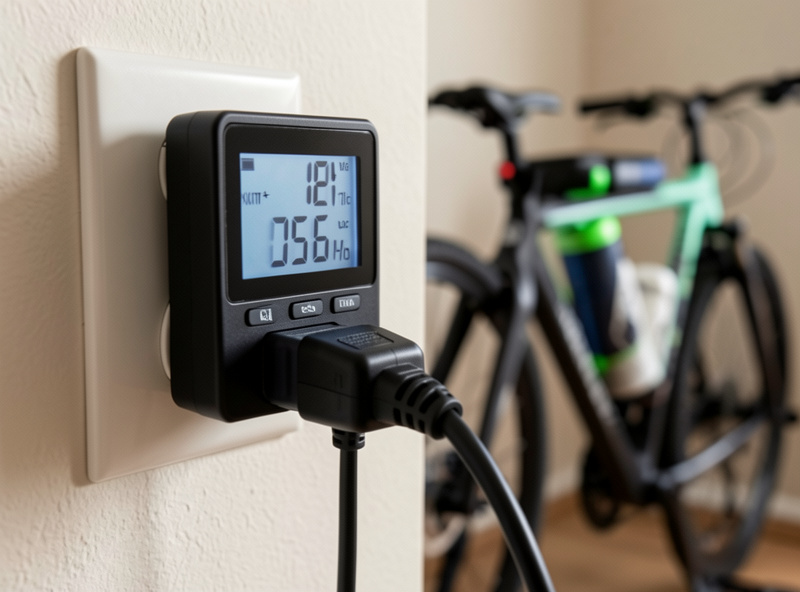
I do not estimate this, I measure it, with a watt-meter on the wall outlet logging exactly what the charger draws. The pack on my bike and every cell on my stationary battery bench get the same treatment, because Wh does not care what it is pushing and guessing is for people who do not own a meter. Here is the honest arithmetic, why the wall draw is higher than the battery rating, and how to work out your own cost in about a minute.
One thing I want to set straight up front: the charging cost is so small that it should never drive a single decision about how you treat the battery. People sometimes hesitate to top up “to save electricity” or run the pack flat “to get their money’s worth” out of a charge. Both are false economies built on a number that does not matter. The energy is pennies; the battery is the asset. Once you have measured the cost once and seen how tiny it is, you can stop thinking about it and focus on the habits that actually protect the expensive part.
How Much Does One Full Charge Cost?
To find the cost of a full charge, multiply your battery’s usable watt-hours by your local price per kilowatt-hour, then add roughly 10-15% for charging losses. A 500 Wh pack is 0.5 kWh of stored energy; at a price of, say, 30 cents per kWh that is about 15 cents of stored energy, or roughly 17 cents once you add the losses. Swap in your own numbers and you have your per-charge cost.
The reason the wall draw is higher than the battery’s rating is real and worth understanding: the charger itself is not perfectly efficient, and some energy is lost as heat during charging, so the outlet delivers more than the cells store. That overhead is why my watt-meter consistently shows a full charge pulling a bit more than the pack’s nominal capacity. It is a small difference, but it is the difference between a guess and a real number, and the same logging underpins the methodology in my real-world range calculator.
What Does a Year of Charging Cost?
For a typical commuter, a year of e-bike charging usually lands somewhere between the price of a few coffees and a single tank of car fuel. If you ride enough to need three full charges a week, that is around 150 charges a year; at the per-charge cost above, the annual electricity bill for the bike is genuinely small, often less than what many people spend on transport in a single week.
The exact figure depends on three things: how far you ride, how much assist you use, and your local electricity price. Higher assist levels and hillier routes use more watt-hours per kilometre, so they cost a little more to charge, though “more” here still means pennies. The assist-level effect on consumption is its own topic, which I break down in e-bike assist level and battery use, and the terrain effect in Wh per km by terrain.
Worked Example: A Real Annual Cost
Here is the calculation laid out so you can copy it with your own numbers. Take a 500 Wh pack, a rider who fully depletes and recharges it three times a week, and an electricity price of 30 cents per kWh. That is 0.5 kWh per charge, plus about 12% losses, so roughly 0.56 kWh drawn per full charge.
| Input | Value | Result |
|---|---|---|
| Battery capacity | 500 Wh = 0.5 kWh | Energy stored per charge |
| Charging losses | ~12% | ~0.56 kWh drawn at the wall |
| Electricity price | 30 cents per kWh | ~17 cents per full charge |
| Charges per week | 3 | ~51 cents per week |
| Charges per year | ~150 | ~25 currency units per year |
Adjust the price and the charge frequency to your own situation and the method holds. Even at a high electricity price and heavy use, the annual cost stays in the territory of a single restaurant meal, which is exactly why “what does it cost to charge” is the easiest question in e-bike ownership to answer happily.
Note that this assumes you fully drain and refill the pack each time, which most riders do not. If you usually top up from half rather than empty, you are drawing roughly half the energy per charge, so the real annual figure for a typical commuter who part-charges is often lower still. The arithmetic scales linearly: half the depth of discharge, half the energy, half the cost. The headline stays the same regardless, which is that the number is trivially small.
Is It Cheaper to Charge at Off-Peak Times?
If you are on a time-of-use electricity tariff, charging during off-peak hours costs less per kWh, so yes, timing the charge can shave the already-small bill further. On a tariff with a cheap overnight rate, scheduling the charge for those hours is free money, with one caveat that matters more than the savings.
That caveat is battery longevity: a charge timed to finish hours before you ride means the pack sits at full overnight, which adds calendar aging. The neat solution is to schedule the charge to finish close to when you leave, capturing the off-peak rate without the long sit at 100%. It is a small optimization, but it is the kind of thing a watt-meter and a little attention make obvious, and it costs nothing once you set it up. The longevity side of this is covered in my charging habits guide.
If you go the smart-plug route to schedule charging, use a reputable plug rated comfortably above the charger’s draw, and treat it as a timer rather than a safety device; it does not replace charging on a sensible surface in a space with a smoke alarm. I keep this deliberately simple: a timer to catch the cheap rate, the charge finishing near departure, and the same common-sense placement I would use without any of it. The savings are real but small, so they are worth capturing only because they happen to line up perfectly with the longevity habit of not parking the pack at full.
How Does It Compare to Driving?
The honest comparison is stark: an e-bike costs a small fraction of a cent per kilometre in electricity, while a car costs many times that in fuel alone before you count insurance, parking, and maintenance. Even against public transport, a daily e-bike commute usually undercuts a monthly transit pass within the first couple of weeks of the month. The running cost is so low that for most commuters the bike effectively pays its electricity bill in pocket change.
I will not give you a precise “save X versus your car” figure, because that depends on your fuel price, your car, and your route, and a made-up number would be exactly the kind of false precision I avoid. What I can say with confidence, having logged my own charges for years, is that the directional answer is overwhelming: charging an e-bike is one of the cheapest ways to move a human being any distance, and the electricity cost is rarely worth a second thought once you have measured it once. The bigger ownership costs are tyres, brake pads, chains, and the occasional service, not the energy.
What Makes the Cost Go Up (a Little)?
Three things nudge the charging cost upward, all of them modest. A bigger battery stores more energy, so a full charge of a 750 Wh pack costs proportionally more than a 500 Wh one. Higher assist levels and hillier routes burn more watt-hours per kilometre, so you charge more often. And a less efficient or aging charger wastes a little more as heat. None of these turns a cheap habit into an expensive one; they shift it from “trivial” to “slightly less trivial”.
The one genuine cost worth watching is not the electricity at all but the battery itself, which is the expensive component and the one whose lifespan your charging habits actually influence. Spending a few extra cents to charge gently is irrelevant; treating the pack well so it lasts six years instead of three is where the real money lives. That is why I care far more about how I charge than what it costs me to charge.
Measuring Your Own Cost
The honest way to know your charging cost is to measure it for a week with an inline energy meter, then multiply by your electricity price. A cheap plug-in meter sits between the wall and the charger and totals the kWh, removing all the estimating; after a week you know your real weekly energy and can scale it to a year with confidence. A simple plug-in energy meter is inexpensive and doubles as a battery-health early-warning tool. As an Amazon Associate I earn from qualifying purchases.
Beyond the cost curiosity, that same meter is the most useful diagnostic you can own, because a pack that suddenly needs more energy to reach full, or takes much longer, is flagging a health change long before the range drops on the road. Cost and care turn out to be the same measurement, which is why this number sits inside the broader battery care guide: knowing what goes into the pack tells you both what you spend and how the battery is doing.