Important Disclaimer
eBikeGarageHQ provides educational content and estimates only. We are not certified installers, financial advisors, or electricians. Always consult with licensed professionals.
E-bike battery care is habits, not heroics: charge partially, never store the pack full or empty, charge it warm, and use the supplied charger. Do that and a quality 500 Wh pack holds most of its capacity well past 500 cycles, which is several years of commuting.
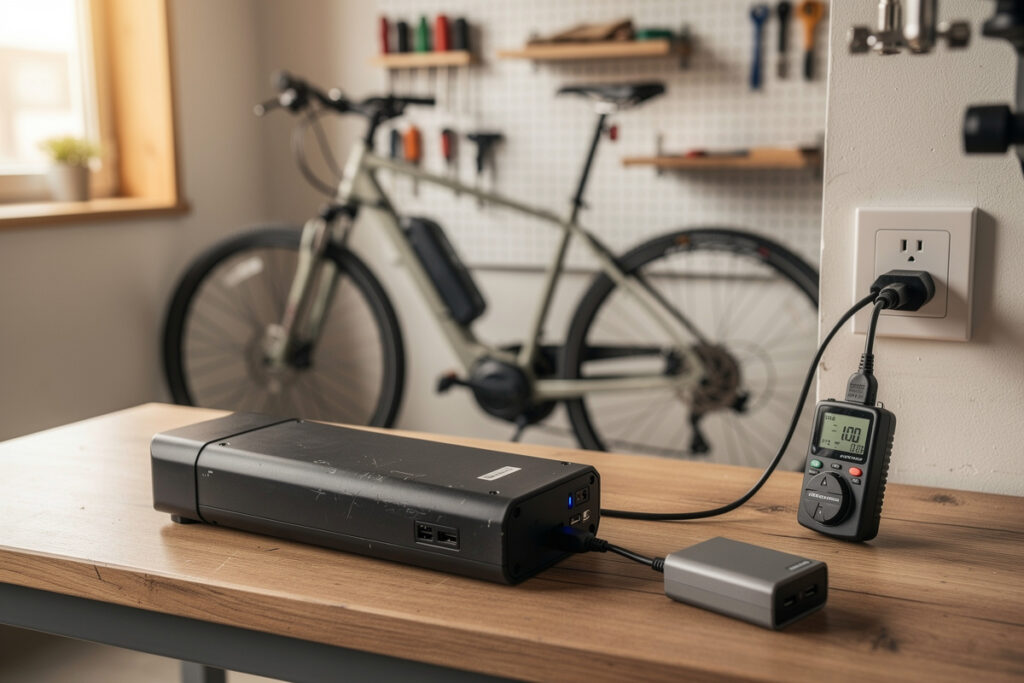
Those four habits cover almost everything that decides whether your pack lasts three years or six, and none of them takes more than a setting change or a calendar reminder. I run an actual battery bench. The pack on my e-bike and the bank on my battery wall obey the same lithium-ion chemistry, so I treat my bike’s battery with the same discipline: I log charges at the wall with a watt-meter, I track how far capacity has faded over the seasons, and I know exactly which habits move the needle and which are folklore. This guide is the whole picture; the deeper questions each get their own article linked below.
One thing I will not do here, or anywhere on this site, is teach you to open a pack. Cell-level work, BMS bypassing, and charger modification are genuine fire risks and they are off the menu completely. Everything below is care you do from the outside, with the battery sealed and the charger the manufacturer shipped. That single rule keeps the rest of this guide both useful and safe.
What Actually Wears an E-Bike Battery Out?
Three things age a lithium-ion e-bike battery: cycle count, calendar time, and stress. Cycle count is how many full charge-discharge equivalents the pack has seen; calendar aging happens whether you ride or not; and stress means heat, sitting at 100% or 0% for long stretches, and high charge or discharge currents. Most riders never wear out the cells through cycling, they age the pack through neglect during storage.
A modern e-bike pack is built from 18650 or 21700 cylindrical cells, the same format I use on my stationary bench, managed by a battery management system (BMS) that balances cells and cuts off at the safe voltage limits. The BMS protects you from the dangerous extremes, but it does not protect you from the slow stuff. Leaving a pack at full charge in a hot car all summer is perfectly “safe” by the BMS, and it is exactly how you lose capacity fastest.
It helps to separate the two clocks. The cycle clock ticks every time you put energy through the cells; a “cycle” is one full pack’s worth of energy, so two half-charges count as one. The calendar clock ticks regardless, and it runs faster when the cells are hot and held near full voltage. A pack that lives at 90-100% in a warm room loses capacity to the calendar even if you never ride it. That is why a bike abandoned over winter at full charge can come out of storage worse than a bike that was ridden hard all season.
There is a comforting corollary to all this: the failure modes that actually strand riders are mostly self-inflicted and avoidable, not random. A pack that is kept in a sane temperature range, charged with the right charger, and never abandoned at the extremes of charge for months will almost always reach old age gracefully, fading a few percent a year rather than dying suddenly. Sudden death usually traces back to physical damage, water ingress, a dodgy aftermarket charger, or deep-discharge neglect, every one of which is in your control from the outside.
The practical takeaway: you cannot stop aging, but you control most of its speed. The habits in this guide all target the stress lever, because that is the one in your hands. The cells you cannot reach; the conditions you keep them in, you can.
Charge to 80% or 100%?
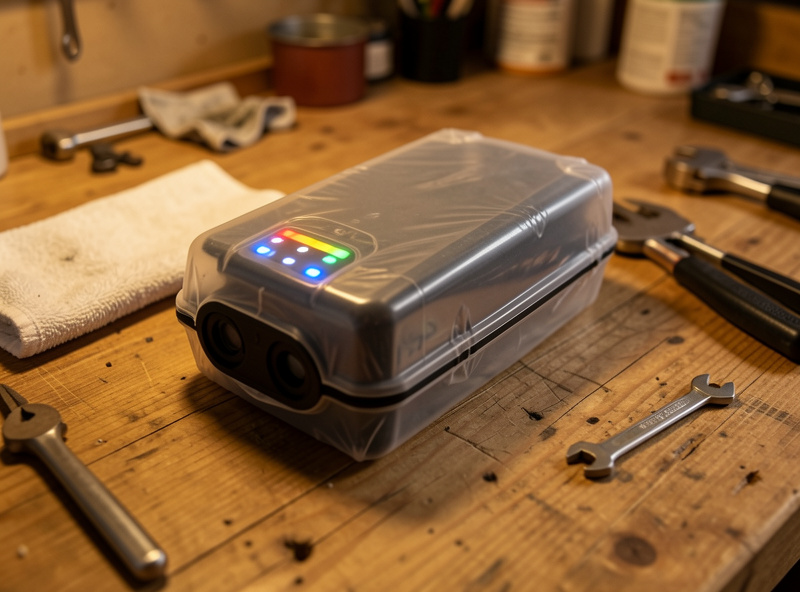
For daily riding, charging to about 80% and topping to 100% only when you need the full range is the gentlest routine, because the top 10-15% of the charge window puts the cells at their highest voltage, which is where calendar aging accelerates. If your bike has a charge-limit setting or a smart charger, 80-90% daily is the easy win.
That said, do not turn this into anxiety. A full charge before a long ride is fine and you should never skip range you actually need. The damage from occasional 100% charges is small; the damage from sitting at 100% for weeks is not. Charge full, ride, and you have lost almost nothing. The thing to avoid is plugging in to 100% out of habit and then leaving the bike parked at that voltage for days.
On my own commuter I leave the charge limit at 90% most weeks and bump it to full the night before a long weekend ride. It is a thirty-second decision, not a lifestyle. The full breakdown of the trade-off, including how much capacity the top of the window actually costs you over years, is in should you charge your e-bike battery to 80 or 100.
How Should I Store the Battery Over Winter?
Store an e-bike battery at roughly 40-60% charge, somewhere cool and dry and indoors, and top it back into that window every couple of months. Storage charge is the single highest-leverage habit for a bike that sits all winter, because a pack parked at full or near-empty for months loses capacity it never gets back, while a pack at half charge in a stable room barely ages at all.
Cool is good, freezing-then-charging is not, and you should never charge a battery that is below freezing; let it warm to room temperature first. There is also a floor risk at the bottom: a pack left near empty can self-discharge below the BMS cutoff over months and become unrecoverable, which is why “half charged” beats “I’ll just run it down and leave it.” Half charge gives you headroom in both directions.
I keep my winter pack on a shelf in the heated part of the garage, set a calendar reminder for every eight weeks, and check the indicator lights when it pings. If it has drifted low, a short top-up back to the middle of the window and it goes back on the shelf. That is the entire ritual. The seasonal detail, including the indoor-versus-shed question for cold climates, is covered in e-bike winter battery storage.
How Long Should an E-Bike Battery Last?
A good e-bike battery is generally rated for 500-1,000 full-charge cycles to roughly 80% of its original capacity, which for most commuters is three to six years of normal use before the range loss becomes noticeable. Manufacturers quote the 500-cycle figure conservatively; with the storage and charge habits in this guide, real packs routinely beat it.
Capacity fade is gradual and front-loaded: you lose a little in the first year, then the curve flattens for a long stretch before it steepens again near end of life. The number that matters is not “cycles” in the abstract but how many usable watt-hours you have left on your real route. A pack at 80% of a 500 Wh rating still has 400 Wh, which is plenty for most commutes; the day it stops covering your daily ride is the day it is “worn out” for you, regardless of what the spec sheet says.
I track mine by logging the same loop, in similar weather, at the same assist level, and charging from the same low point. Watching that number drift down a few percent a year tells me far more than any cycle counter. The methodology and what realistic fade actually looks like year by year is in e-bike battery lifespan expectations, and it leans on the same range-log discipline I describe in my e-bike range guide.
Which Charging Habits Actually Extend Battery Life?
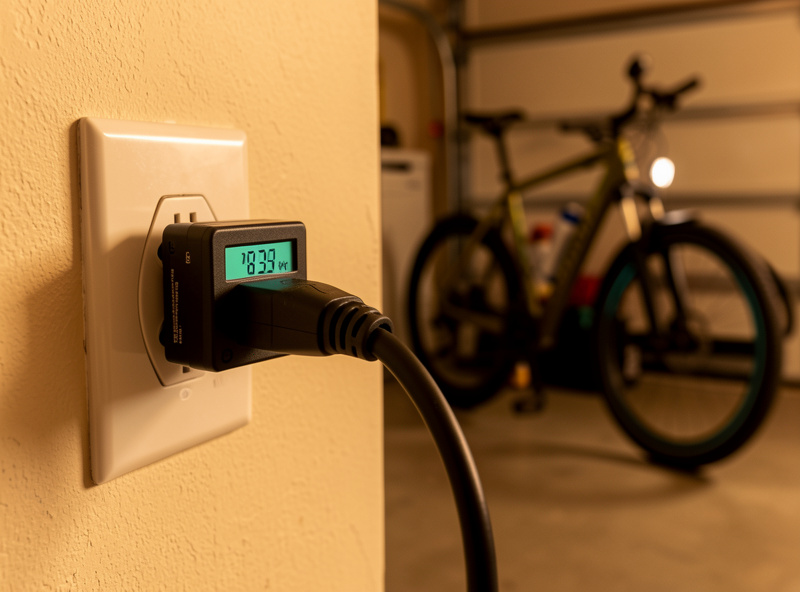
The habits that measurably help: charge at room temperature, avoid leaving the pack at 100% for long periods, top up before it hits empty rather than running it flat repeatedly, and use the charger the bike shipped with. Deep discharges and sustained high heat are the two biggest avoidable stressors, and partial charging beats deep cycling for longevity.
Notice what is not on the list: you do not need to “condition” a lithium battery, you do not need to fully discharge it to “reset” anything (that is nickel-battery folklore), and a faster charger is not automatically worse if it is the right one for your pack. Heat is the quiet killer most people miss, so I never charge a pack straight after a hard summer ride while it is still warm to the touch; ten minutes to cool first costs nothing.
The full habit-by-habit ranking, including which myths to ignore and which small changes give the biggest return, is in charging habits that extend e-bike battery life.
Is a Second Battery Worth Buying?
A second battery is worth it if you genuinely need more range than one charge gives you on a regular ride, or if you want a fresh spare to rotate as the original fades, but a quality pack is a meaningful spend, so the case is strongest for long-distance commuters and tourers rather than short-hop riders. For most people, better charge habits add more usable life than a second pack adds convenience.
Rotating two packs also halves the cycle count each one accumulates, which spreads the aging across both, a real benefit if you ride high mileage. There is a subtlety here, though: a spare you buy now and rarely use still ages on the calendar, so a battery bought “for later” is not in suspended animation. If you buy a second pack, use both in rotation rather than letting one sit at full on a shelf.
There is also a quiet upside people forget: a second pack is a hedge against the day your original needs replacing. If your bike uses a pack that is still in production, you are fine; if it is an older or niche platform, a spare bought while they are available can keep the bike rideable for years after the original wears out. That is a different reason to buy than “more range”, and it changes the math for anyone on a less common bike.
The honest cost-benefit, including the genuinely-direct-sold packs versus what is sensibly bought aftermarket, the warranty traps, and when a spare is a smart hedge versus a slow-aging shelf ornament, is in is a second e-bike battery worth it.
What Does It Actually Cost to Charge?
Charging an e-bike is remarkably cheap: a full charge of a 500 Wh battery uses a little more than 0.5 kWh from the wall once you account for charger inefficiency, so at typical residential electricity rates a full charge costs only a few cents to perhaps twenty cents depending on where you live. Over a year of commuting, the electricity to run an e-bike is a rounding error next to almost any other form of transport.
I measure mine at the wall with a watt-meter rather than guessing, because the charger and the charging losses mean the wall draw is higher than the battery’s rated watt-hours, and that overhead is real and worth knowing if you want an honest number. Multiply your pack’s usable Wh by your local price per kWh, add roughly 10-15% for losses, and you have your per-charge cost; the arithmetic and the watt-meter method are laid out in e-bike wall charging cost math.
The reason I bother measuring such a small number is not the money, it is the diagnostic value. A pack that suddenly draws noticeably more energy to reach full, or that takes much longer than it used to, is telling you something about its health long before the range collapses on the road. The watt-meter pays for itself not in saved cents but in early warning, and the same logging habit underpins everything I publish about real range and capacity fade.
EU and US Rules Do Not Change Battery Care
Battery care is identical whether you ride an EU pedelec (pedal-assist limited to 250 W continuous and a 25 km/h cutoff) or a US Class 1, 2, or 3 e-bike (pedal-assist or throttle to 20 mph, with Class 3 pedal-assist allowed up to 28 mph). The chemistry does not read your local regulations. What does vary by region is which packs and chargers are legally sold and what your warranty covers, so buy the pack specified for your bike and your market and keep the charger that came with it.
The one regulatory care note worth making: use a charger and battery certified for your region, and if a pack is damaged, swollen, or behaving oddly, stop using it and consult the manufacturer or a professional. That is the entire safety line, care from the outside, defer the rest to people with the right equipment. The class system affects how fast you are allowed to go, not how you should treat the cells underneath you.
Heat, Cold, and Why Temperature Rules Everything
If there is a single environmental factor that decides how your pack ages, it is temperature, in both directions. Lithium-ion cells are happiest charging and resting in the 10-30 degrees C range; above that, calendar aging speeds up, and below freezing, charging can plate lithium onto the cell internals and cause permanent damage. Riding in the cold is fine, the pack just gives you less range until it warms; charging in the cold is the one to avoid.
In a Nordic winter I treat the battery as a houseguest. It comes inside to charge, warms to room temperature before the charger goes on, and only goes back out to ride once it is full and acclimatized. In summer the rule flips: keep it out of the parked-car oven and out of direct sun, and let a hot pack cool before charging. None of this is fussy, it is just paying attention to where the pack sits when it is not moving, which ties straight into the winter storage routine and explains a good chunk of the seasonal range swing covered in my range methodology.
The reason temperature outranks almost everything else is that it acts on both clocks at once: heat accelerates calendar aging while you do nothing, and cold charging causes immediate, irreversible harm. Get temperature right and the other habits are just fine-tuning.
Reading Your Pack Without Opening It
You can learn a surprising amount about a battery’s health from the outside, no disassembly required. The honest measure is usable range on a repeatable route: charge from the same low point, ride the same loop at the same assist in similar weather, and watch the watt-hours consumed and the range delivered drift over the seasons. That number, not a cycle counter, tells you what the pack will actually do for you.
A watt-meter on the wall gives you the input side; your bike’s display or a logging app gives you the output side. Between them you can see fade arriving years before it strands you, and you can tell the difference between a genuinely tired pack and one that is just cold today. This is the same instrument discipline I bring to every charge, and it feeds directly into the lifespan expectations and charging-cost math in the spokes below. What you never do is crack the case to “check the cells”, that is exactly the line this site does not cross.
The Care Routine I Actually Follow
Strip away the theory and my routine is short: daily charge limit around 90%, full only before a genuinely long ride, never plug in a hot pack, never store it full or empty, and a watt-meter on the charger so I am working from numbers instead of vibes. Five habits, all low-effort, and between them they cover almost everything that determines whether a pack lasts three years or six.
If you only change one thing today, make it the storage habit: a pack that spends its idle months at half charge in a stable indoor temperature will outlast one babied on every ride but abandoned full over winter. Care is mostly about the time the battery spends not being ridden, which is most of its life. The rest of this cluster goes deep on each decision, but this is the floor to stand on.
E-Bike Battery Care at a Glance
| Habit | What to do | Why it matters | Effort |
|---|---|---|---|
| Daily charging | Charge to 80-90%; full only when you need the range | Top voltage accelerates calendar aging | Low (one setting) |
| Storage | Park at 40-60%, cool/dry/indoors, top up every ~2 months | Biggest avoidable capacity loss happens in storage | Low (a reminder) |
| Temperature | Charge at room temp; never charge a sub-freezing pack | Cold charging and sustained heat both stress cells | Low |
| Discharge | Top up before empty; avoid repeated flat-out runs | Deep discharge cycles age the pack faster than partial ones | Low |
| Charger | Use the supplied/certified charger; measure draw if curious | Wrong or modified chargers are a safety and longevity risk | None |
| Second pack | Worth it for high mileage; rotate to spread cycles | Halves the cycles each pack sees, adds range | Cost-dependent |
Frequently Asked Questions
Should I leave my e-bike battery on the charger overnight?
Occasionally is fine since the BMS stops charging when full, but routinely leaving it at 100% for many hours adds avoidable calendar aging. For daily use, charge to about 80-90% and unplug rather than parking the pack full overnight.
Does fully draining an e-bike battery help or hurt it?
It hurts. Lithium-ion packs prefer partial cycles; repeatedly running to empty stresses the cells more than topping up early. There is no need to fully discharge to calibrate anything, that is old nickel-battery advice that does not apply.
How many years will an e-bike battery last?
Most quality packs are rated for 500-1,000 cycles to about 80% capacity, which is roughly three to six years of normal commuting. Good storage and charge habits routinely push real-world life past the conservative cycle rating.
Can I charge my e-bike battery in the cold?
Never charge a battery that is below freezing, as cold charging can permanently damage lithium-ion cells. Bring the pack indoors and let it reach room temperature first, then charge. Discharging by riding in the cold is fine; it just reduces range temporarily.
What state of charge is best for storing an e-bike battery?
Around 40-60%, kept cool, dry, and indoors. A pack stored at full or near-empty for months loses capacity it will not recover, while a half-charged pack in a stable room ages very slowly. Top it back into that window every couple of months.
Is it worth charging only to 80 percent every time?
For longevity, yes, but do not let it cause range anxiety. Daily 80-90% charging reduces top-voltage stress, while charging to 100% before a genuinely long ride costs almost nothing. The damage comes from sitting at 100%, not from reaching it.
Related Guides
- Should You Charge Your E-Bike Battery to 80 or 100?
- E-Bike Winter Battery Storage: The Half-Charge Rule
- E-Bike Battery Lifespan: How Many Years to Expect
- Charging Habits That Extend E-Bike Battery Life
- Is a Second E-Bike Battery Worth It?
- E-Bike Wall Charging Cost Math
If your interest runs past bikes into stationary lithium storage, the deeper chemistry and BMS coverage lives on my battery storage site, same bench, same instruments, more headroom on the technical side.