Important Disclaimer
eBikeGarageHQ provides educational content and estimates only. We are not certified installers, financial advisors, or electricians. Always consult with licensed professionals.
A hub motor pushes the wheel; a mid-drive turns the cranks and rides on your gears. That single difference decides hill behavior, maintenance load, ride feel, and how the bike handles a load — far more than the motor’s wattage on the box. After years of running a Bosch mid-drive trekking bike, an Aventon-class hub-drive commuter, and a Bafang-class mid-drive I bolted onto a donor frame myself, my verdict is simple: the motor type matters more than the brand, and where the weight sits matters more than the spec sheet. This guide is the one I wish someone had handed me before I bought my first e-bike.
I’ll be precise about the legal frame too, because half the confusion online comes from people quoting the wrong rules. I ride in the EU, where a pedal-assist e-bike (a pedelec) is capped at 250 W continuous rated power and assistance cuts out at 25 km/h. The US uses a three-class system: Class 1 (pedal-assist to 20 mph / ~32 km/h), Class 2 (throttle to 20 mph), and Class 3 (pedal-assist to 28 mph / ~45 km/h). Those numbers are not interchangeable, and any article that blurs them is one to close.
The Core Difference: Where the Motor Lives
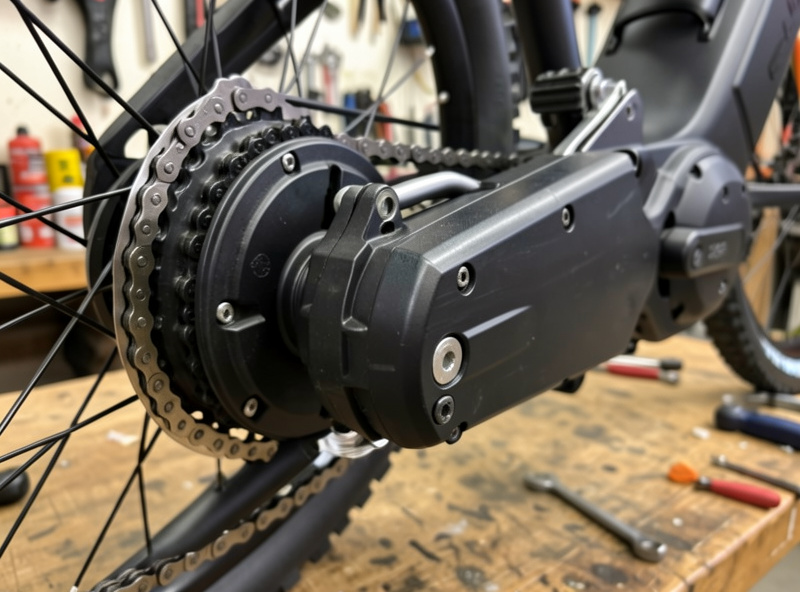
A hub motor is built into the wheel — almost always the rear wheel on a decent bike — and it spins that wheel directly. It’s a self-contained unit: power in, wheel turns, done. A mid-drive sits at the bottom bracket, between the pedals, and drives the chain through your existing cassette and chainring. That means a mid-drive multiplies its torque through your gears exactly the way your legs do, while a hub motor pushes against the road at one fixed mechanical ratio.
That distinction is the root of everything else in this guide. On my mid-drive, dropping to a low gear lets the motor spin in its efficient range while still grinding up a steep ramp. My hub-drive can’t do that — in a low gear or a high one, the motor turns the wheel at whatever speed the wheel turns, and on a steep enough hill it bogs, heats up, and draws hard from the battery. Neither is “better” in the abstract. They’re good at different things, and the rest of this page is about matching them to how you actually ride.
Hub Motor vs Mid-Drive: The Honest Comparison
Here’s the side-by-side I’d hand a friend deciding between the two. These are tendencies from owning both, not absolutes — a premium hub bike can outclass a cheap mid-drive on everything except gear-multiplied climbing.
| Factor | Hub Motor (rear) | Mid-Drive |
|---|---|---|
| Hill climbing | Adequate on rolling terrain; bogs and heats on sustained steep grades | Excellent — multiplies torque through your gears |
| Ride feel | Push-from-behind; can feel like a scooter, especially with cadence sensing | Bike-like; amplifies your own pedaling, especially with a torque sensor |
| Drivetrain wear | Low — motor doesn’t load the chain | Higher — all motor torque runs through chain and cassette |
| Maintenance access | Rear-wheel jobs (flats, spokes) are more awkward | Wheels come off normally; bottom bracket area is busier |
| Weight distribution | Heavy at the rear wheel | Centered, low — best balance and handling |
| Typical cost | Lower — the value-bike default | Higher — the premium-bike default |
| Conversion friendliness | Simplest DIY kit | More involved; needs torque arm discipline and gear awareness |
If you take one thing from that table: hub motors win on simplicity and price, mid-drives win on hills, handling, and ride feel. The crossover question — which one is right for you — comes down to terrain, how much you’ll wrench, and whether the bike-like ride is worth the premium and the drivetrain wear.
Stop Buying on Watts and Newton-Metres
The single biggest mistake I see is people comparing a hub bike and a mid-drive by the numbers on the box — peak watts and peak torque in Nm — as if they were directly comparable. They’re not, and here’s the part the marketing hides: a mid-drive’s torque figure is measured at the motor, before your gears multiply it. A hub motor’s torque is measured at the wheel, where it’s actually applied. So a mid-drive rated at 85 Nm and a hub motor rated at 85 Nm are not equals — the mid-drive can effectively multiply its figure several times over in a low gear, while the hub motor is stuck with what it makes. Comparing those two numbers side by side is meaningless.
Wattage is just as misleading, partly because of the law. In the EU a road-legal pedelec is rated at 250 W continuous regardless of motor type, so the headline figure tells you almost nothing about how the bike climbs — a well-geared 250 W mid-drive will out-climb a 250 W hub motor every time, because the mid-drive applies its modest power where it’s useful. What actually matters is the system: motor type, gearing, sensor, and how the manufacturer tuned the controller. I’ve ridden bikes with identical spec-sheet numbers that felt like completely different machines. Trust the ride and the motor architecture, not the figures.
Hills: The Question That Decides Most Buyers
If you live somewhere flat, this section barely matters and you can buy on price. If you live anywhere with real climbs, it’s the whole ballgame. A mid-drive gears down with you, so on a 12% ramp it stays in its efficient RPM band and keeps making torque while you spin a low gear. A hub motor is stuck at one ratio: on that same ramp it falls out of its efficient speed, current spikes, heat builds, and on a long enough climb a cheaper hub motor will reduce power to protect itself.
I’ve logged both up the same hill on my test loop. The mid-drive walked it in a low gear barely breathing; the hub bike got there but warm and thirsty, pulling noticeably more from the battery for the same climb. That’s not a brand failing — it’s physics. I go deep on this in the dedicated hub motor vs mid-drive on hills breakdown, including how gearing and grade interact and why “Nm on the box” doesn’t tell you what you need to know.
There’s a heat angle here too that nobody mentions at the point of sale. When a hub motor labours below its efficient speed on a long climb, it isn’t just slow — it’s converting more of its energy into heat inside a sealed wheel that can’t shed it quickly. That’s why cheaper hub bikes throttle themselves back on extended grades: it’s thermal self-protection, not a software bug. A mid-drive keeps its RPM up by gearing down, so it runs cooler doing the same work. If your daily ride includes one long, sustained climb rather than a series of short rollers, that single fact should weigh heavily toward a mid-drive.
The Sensor Underneath: Torque vs Cadence
People obsess over hub-vs-mid and ignore the thing that actually shapes the ride: the assist sensor. A cadence sensor just detects that the pedals are turning and delivers a preset level of power — turn the pedals, get a push, like a switch. A torque sensor measures how hard you’re actually pressing and scales assist to your effort, so the bike feels like an amplified version of your own legs.
This cuts across the hub/mid question — you can find torque-sensing hub bikes and cadence-sensing mid-drives — but in practice the premium torque-sensor feel shows up most on quality mid-drives. Once you’ve ridden a good torque-sensor bike, a cadence-only system feels like an on/off scooter throttle by comparison. I unpack exactly what each one feels like, and which is worth paying for, in torque sensor vs cadence sensor feel.

Maintenance: The Cost Nobody Quotes You
The brochure never mentions that a mid-drive runs every watt of its torque through your chain and cassette. On my mid-drive, the drivetrain wears faster than any acoustic bike I’ve owned — I track chain stretch and swap the chain earlier than I would on the hub bike, because letting it go ruins the cassette under that load. A hub motor doesn’t touch the drivetrain at all, so its chain wears like a normal bike’s; its maintenance quirks live elsewhere (rear-wheel jobs, spoke checks on a heavy motorized wheel).
Neither is high-maintenance if you stay ahead of it, but they ask for different rhythms. I lay out the real intervals — chain wear under motor torque, brake pads at e-bike weight, spoke and bottom-bracket checks — in the honest hub vs mid-drive maintenance comparison. The short version: budget for drivetrain consumables on a mid-drive, and budget your patience for rear-wheel work on a hub.
Weight Distribution and How the Bike Actually Rides
A rear hub motor plus the battery (often on the rear rack or down tube) can put real mass behind and above the rear axle. You feel it in low-speed handling, when you lift the bike onto a rack, and in how the front end behaves on loose surfaces. A mid-drive carries its motor low and central, right where a frame designer wants the mass, so the bike handles closer to a normal bicycle — better balance loaded, calmer in corners, easier to manhandle.
This is the most underrated factor on the whole page, because it’s the one you feel on every single ride rather than only on hills. I dig into how the weight position changes cornering, loaded stability, and the lift-it-onto-a-train test in e-bike weight distribution and riding feel.
Which One for Commuting?
For a daily commuter, the honest answer depends on your route and your wallet, not on which motor is “best.” A torque-sensor mid-drive is the nicest thing to ride to work — bike-like, balanced, strong on any hill — but it costs more and you’ll be replacing chains. A good hub-drive is the value champion: cheaper, drivetrain-friendly, and on a flat-to-rolling commute you may never miss the mid-drive’s hill talent. I make the full case both ways, by route type and budget, in hub or mid-drive for commuting.
If You’re Converting a Bike Yourself
The motor choice changes completely when you’re building rather than buying. I converted a donor bike with a Bafang-class mid-drive kit, and the decision tree there is different: a hub-motor conversion is the simplest DIY path (it’s basically a wheel swap plus a controller and a bought battery pack), while a mid-drive conversion is more involved and demands real attention to torque arms, dropouts, and the fact that you’re now feeding motor torque through your bike’s original drivetrain. I keep all of this strictly at kit-and-bought-pack level — there is no DIY battery-pack building anywhere on this site, full stop, because that’s how houses burn down. The full build-bench breakdown is in conversion kit implications: hub vs mid-drive.
Range and Efficiency: A Closer Race Than You’d Think
You’ll read that mid-drives are “more efficient” and therefore go further on the same battery. It’s true in the situation that matters most — climbing — because the mid-drive keeps the motor in its sweet spot through gearing, so it wastes less energy as heat on hills. On my test loop with real elevation, the mid-drive consistently posts a lower Wh/km on the climbing sections. But on flat ground at a steady cruise, a good hub motor is humming along efficiently too, and the gap narrows to almost nothing. Range is a Wh-divided-by-Wh-per-km problem, and on flat terrain both motor types land in a similar place.
So if maximum range on flat-to-rolling ground is your priority, don’t pay the mid-drive premium expecting a huge range win — you mostly won’t get one there. The mid-drive’s efficiency advantage is real but it’s concentrated in the hills. This is exactly the kind of arithmetic I run on the bench: usable watt-hours in the pack, measured Wh/km for your terrain and assist level, and the honest range falls out. I keep all the methodology in the e-bike range guide, but the headline for this decision is simple — buy the mid-drive for hills and ride feel, not for a range miracle on the flat.
Reliability, Noise, and What Actually Breaks
Hub motors are mechanically simpler — fewer moving parts touching the drivetrain — and a brushless hub motor is a famously durable thing. The honest weak points on a hub bike are around it: spokes on a heavy motorized wheel can need re-tensioning, and a rear-wheel flat is a more involved roadside job than on a normal bike because you’re dealing with the motor cable and often a torque washer. Noise-wise, a quality geared hub is quiet; some cheaper direct-drive hubs hum.
Mid-drives put more mechanical complexity right at the bottom bracket and run their power through the chain, so the wear items are the drivetrain (chains and cassettes I replace earlier than I would on an acoustic bike) and, over years, the motor’s internal gearing and bearings. A good mid-drive is also slightly more audible under load — a soft mechanical whir on a hard climb — though I’d never call it loud. Neither system is fragile; they just present you different bills. The hub asks for occasional wheel attention, the mid-drive asks for drivetrain consumables. Plan your maintenance budget around which one you choose, and check my full maintenance comparison for the intervals I actually run.
So Which Should You Buy?
Here’s the decision compressed. Buy a mid-drive if you have real hills, you want the bike-like torque-sensor ride, and you’re fine paying more and replacing chains. Buy a hub-drive if your terrain is flat-to-rolling, you want the most range and reliability per krona, and you’d rather not babysit a drivetrain. For a flat-city commute on a budget, the hub bike is the smart-money pick; for hilly terrain or anyone who wants the bike to feel like a great bicycle, the mid-drive earns its premium.
Whichever way you lean, ignore the wattage-and-Nm marketing war and decide on motor type, sensor type, and weight position first. Those three choices determine how the bike feels on every ride for years — the spec numbers on the box don’t. For the range side of the same decision, my e-bike range guide covers how each setup turns watt-hours into actual kilometers, and if you want to understand the pack itself beyond bike scope, the battery deep-dives over at BatteryStorageHQ share the same bench literacy I bring to charge behavior here.
Frequently Asked Questions
Is a mid-drive always better than a hub motor?
No. A mid-drive is better on hills, handling, and ride feel because it multiplies torque through your gears and carries its weight low and central. But a quality hub-drive is cheaper, doesn’t wear your drivetrain, and is more than enough for flat-to-rolling terrain. “Better” depends entirely on your terrain, budget, and how much you want to wrench.
Do hub motors and mid-drives follow the same speed laws?
Yes — the law cares about assist behavior, not motor location. In the EU, any pedelec is limited to 250 W continuous rated power with assist cutting out at 25 km/h regardless of motor type. In the US, the Class 1/2/3 system (20 mph for Class 1 and 2, 28 mph for Class 3) applies the same way to both. The motor type doesn’t change which class a bike is.
Which motor type wears out the chain faster?
The mid-drive. Because it sends all of its torque through your existing chain and cassette, those parts wear noticeably faster than on a non-assisted bike, and I replace chains earlier on my mid-drive to protect the cassette. A rear hub motor doesn’t load the drivetrain at all, so its chain wears at normal-bicycle rates.
Can I convert my existing bike with either motor?
Yes, both exist as conversion kits, but the effort differs. A rear-hub conversion is the simplest DIY route — essentially a motorized wheel, a controller, and a bought battery. A mid-drive conversion is more involved and needs careful torque-arm and dropout attention. On this site I only ever cover kit-and-bought-pack conversions; building battery packs from cells is off-limits for safety reasons.
Does a torque sensor come with mid-drives or hub motors?
Either can have one, but premium torque sensors are most common on quality mid-drives, while budget hub bikes often use a simpler cadence sensor. The sensor shapes how the assist feels far more than the motor location does — a torque sensor scales power to how hard you press, while a cadence sensor delivers a preset push as soon as the pedals turn.
Which is better for a flat city commute?
For a flat-to-rolling commute on a budget, a good torque-sensing hub-drive is the smart-money pick — cheaper, drivetrain-friendly, and you’ll rarely miss the mid-drive’s hill talent. Step up to a mid-drive when you have sustained climbs, you want the most bike-like ride, or you simply want the better-balanced bike and you’re fine with the higher cost and chain maintenance.
Related Guides
- Hub Motor vs Mid-Drive on Hills
- Torque Sensor vs Cadence Sensor Feel
- Hub vs Mid-Drive Maintenance, Honestly
- E-Bike Weight Distribution and Ride Feel
- Hub or Mid-Drive for Commuting
- Conversion Kit Implications: Hub vs Mid-Drive
Related Guides — Complete Spoke List
Full spoke list of the Hub vs Mid-Drive cluster:
- “Conversion Kit Implications: Hub vs Mid-Drive
- “Hub or Mid-Drive for Commuting: Which One to Buy”
- “E-Bike Weight Distribution and Ride Feel: Where the Mass Sits”
- “Hub vs Mid-Drive Maintenance: The Honest Cost of Each”
- “Torque Sensor vs Cadence Sensor: How Each One Feels to Ride”
- “Hub Motor vs Mid-Drive on Hills: What Actually Climbs”
More From This Site
Other guides across hub vs mid-drive and the rest of the Ebikegarage library:
- “E-Bike Charging Cost: The Wall-Outlet Math”
- “Charging Habits That Extend E-Bike Battery Life”
- “E-Bike Battery Lifespan: How Many Years to Expect”
- “E-Bike Winter Battery Storage: The Half-Charge Rule”
- “Is a Second E-Bike Battery Worth It? An Honest Take”
- “Charge Your E-Bike Battery to 80 or 100? The Honest Answer”
- “E-Bike Battery Care: The Habits That Make a Pack Last”
- “Conversion Kit Implications: Hub vs Mid-Drive
- “Hub or Mid-Drive for Commuting: Which One to Buy”
- “E-Bike Weight Distribution and Ride Feel: Where the Mass Sits”
- “Hub vs Mid-Drive Maintenance: The Honest Cost of Each”
- “Torque Sensor vs Cadence Sensor: How Each One Feels to Ride”
- “Hub Motor vs Mid-Drive on Hills: What Actually Climbs”
- “Manufacturer E-Bike Range Claims
- “E-Bike Range Anxiety vs Range Math: Trusting the Numbers”
- “E-Bike Assist Level and Battery Use: Where the Wh Go”
- “Cold Weather E-Bike Range Loss: What a Winter Log Shows”
- “E-Bike Wh per km by Terrain: A Field-Logged Energy Budget”
- “E-Bike Range Calculator: Real-World Numbers
- “E-Bike Range Guide: How Far You Actually Go on a Charge”