Important Disclaimer
eBikeGarageHQ provides educational content and estimates only. We are not certified installers, financial advisors, or electricians. Always consult with licensed professionals.
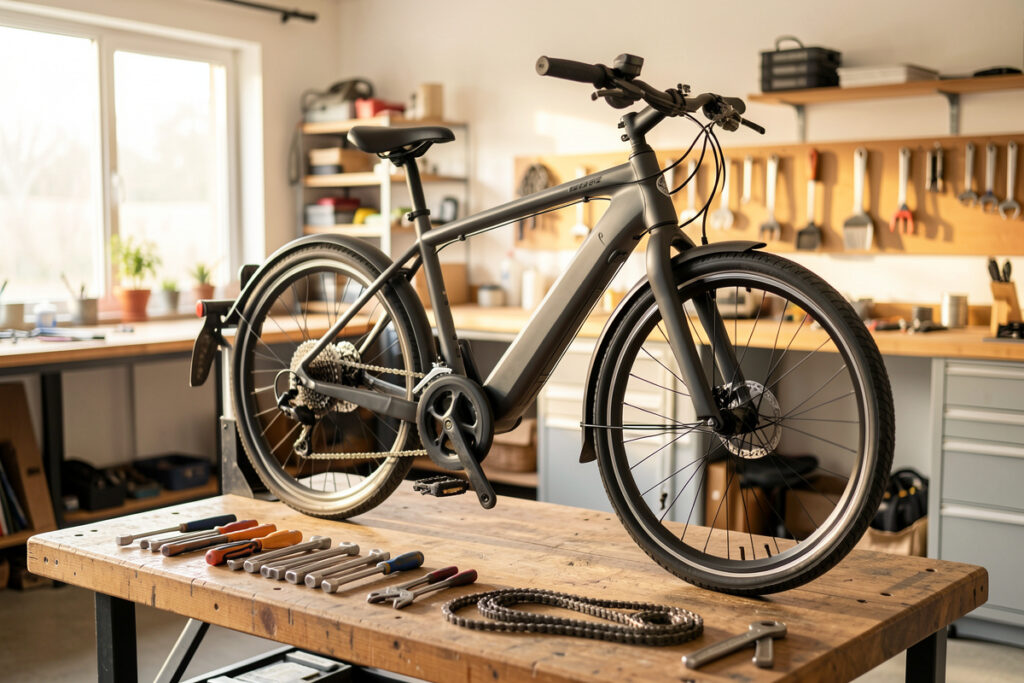
An e-bike needs the same maintenance as any bike, plus a short list of jobs the motor makes non-negotiable. Budget a chain check every 500 km, brake pads at roughly half the life you’d get on an analog bike, and a spoke-tension check on hub motors every service. Skip those three and the drivetrain wear bill arrives fast.
I’ve run mid-drive and hub-drive bikes through four honest Swedish seasons and built a conversion on my own bench, and the pattern is always the same: e-bikes don’t break in mysterious ways, they break faster in the ordinary ways. The extra torque and the extra weight accelerate everything a normal bike does slowly. This guide is the maintenance system I actually run in my garage — what to check, how often, and which jobs you can let slide versus which ones cost you a cassette if you do.
Why E-Bike Maintenance Is Different (and Where It Isn’t)
The honest answer: about 80% of e-bike maintenance is identical to a regular bike, and 20% is genuinely different because of motor torque and system weight. A 25 kg e-bike with a 75 Nm mid-drive puts loads through the chain and cassette that an 11 kg road bike never sees, and it does it at every single start from a traffic light.
That 20% is where people get caught. Riders treat the e-bike like their old commuter, run the chain to death, and then blame the bike when the cassette skips. The drivetrain didn’t fail — it got the wear of three normal years compressed into one. The frame, the headset, the seatpost, the bars: those wear at normal-bike rates. The chain, cassette, brake pads, and on hub bikes the spokes and motor-side bearings: those are on the accelerated clock. Once you know which is which, the whole thing gets simple. You watch the fast-wear parts closely and let the slow ones run on a normal schedule.
The Three Jobs the Motor Makes Non-Negotiable
If you do nothing else, do these three: chain wear monitoring, brake-pad checks, and on hub motors a spoke-tension check. Each one prevents a cheap part from destroying an expensive one — a worn chain eating a cassette, thin pads scoring a rotor, a loose spoke killing a wheel build.
Chain wear is the one that costs the most when ignored. On a mid-drive, the motor’s torque runs straight through the chain, so it stretches faster than the same chain would on an unpowered bike. Once a chain passes 0.75% elongation it starts machining the cassette teeth to match its worn pitch; ride past 1% and you’ll replace chain and cassette instead of just the chain. I cover the mechanism in detail in my guide to chain wear under motor torque, but the headline is simple: a chain replaced on time saves a cassette three times its price. Brake pads come second — e-bike weight and speed mean pads that lasted a year on your old bike now last a season; see the brake pad replacement intervals for the numbers. Third, on hub-motor bikes, spoke tension: the motor’s weight and torque reaction work spokes loose, and a detensioned wheel fails fast. My hub motor spoke tension guide walks through the check.
A Maintenance Schedule That Survives Real Use
Here’s the rhythm I run, built around kilometers rather than calendar months because a bike that does 30 km a day wears nothing like a weekend bike. The fast-wear parts get watched, the rest gets a seasonal pass. This is the same schedule I detail in my seasonal service schedule, condensed into a single table.
| Task | Interval | Why It Matters on an E-Bike | DIY or Shop |
|---|---|---|---|
| Chain wear check (gauge) | Every 500 km | Motor torque stretches chains faster; protects the cassette | DIY |
| Chain lube | Every 200–300 km / after wet rides | Dry chain accelerates wear under load | DIY |
| Brake pad inspection | Every 1,000 km | E-bike weight burns pads roughly twice as fast | DIY |
| Tire pressure | Weekly | Heavier bike, higher pinch-flat and rolling-loss risk | DIY |
| Spoke tension (hub motor) | Every service / 1,500 km | Motor mass and torque reaction loosen spokes | DIY check, shop tension |
| Drivetrain deep clean | Every 1,000–1,500 km | Grit under torque grinds the chainline | DIY |
| Bottom bracket / motor mounts (mid-drive) | Annually | Torque works bolts loose | Shop |
| Brake bleed | Annually | Hydraulic feel degrades; safety-critical at e-bike speed | Shop |
| Firmware / diagnostics | Annually | Catches BMS and sensor faults early | Shop (dealer system) |
The Drivetrain Is Where the Money Is
If you want one place to focus your attention, make it the drivetrain. It’s the system the motor punishes hardest, and it’s the one where neglect cascades fastest from cheap to expensive. A clean, well-lubed, correctly-worn chain protects the cassette and chainring; a gritty, stretched chain destroys both.
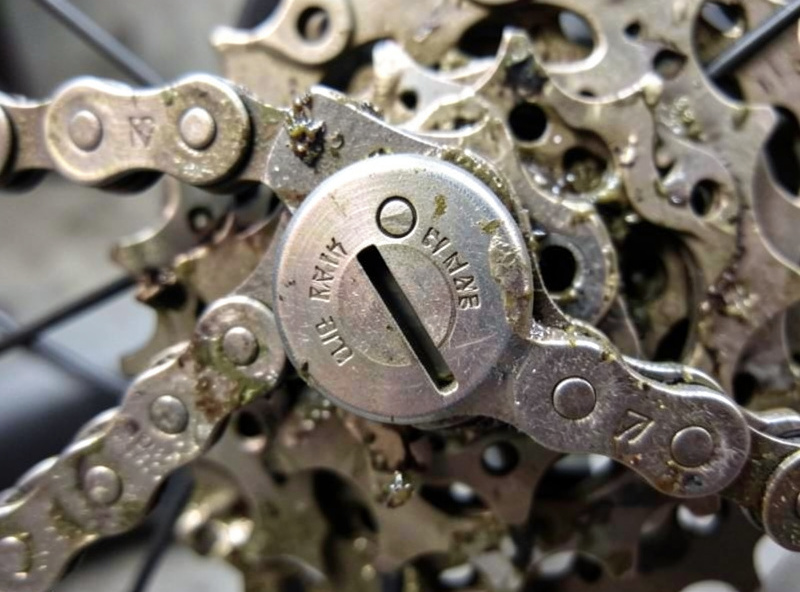
I keep the cleaning honest — degrease, dry, lube, wipe — and I do it more often than I would on a non-assisted bike because grit plus torque is a grinding paste. My full drivetrain cleaning guide covers the routine, but the principle is that a chain wears from the inside out, at the pin-and-roller interface, and that’s exactly where grit gets driven under motor load. A chain you can keep clean is a chain that reaches its wear limit on schedule instead of early. Pair clean habits with on-time replacement and a single cassette will outlast three or four chains, which is the cheapest drivetrain economics you can run.
Brakes: The Safety System Weight Eats Fastest
An e-bike asks more of its brakes than any analog bike you’ve owned: more mass to stop, often higher average speeds, and on Class 3 / faster commuter bikes a real velocity. That shows up as pad life roughly half what you’re used to. On my commuter I plan pad swaps by season, not by year.
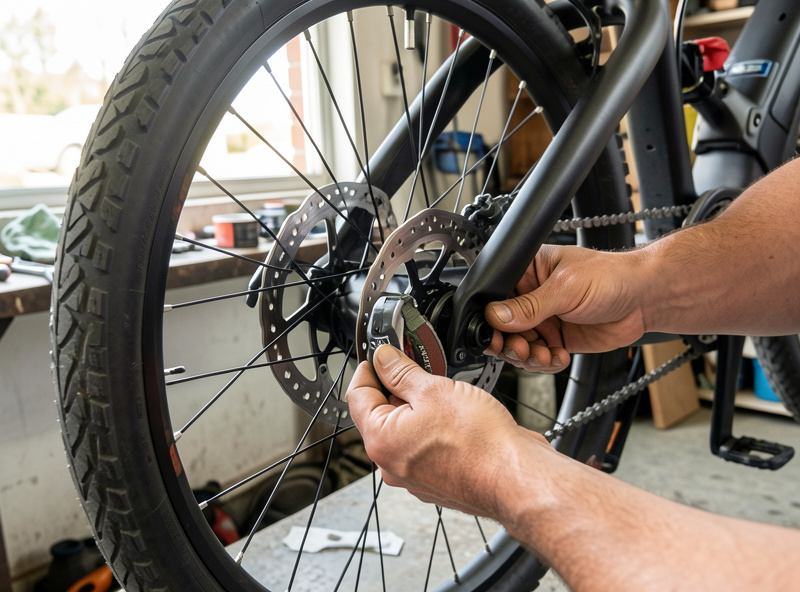
The failure mode that scares me isn’t worn pads — it’s worn-through pads scoring the rotor, turning a cheap pad job into a rotor-plus-pad job, or worse, a glazed brake that won’t haul the bike down on a wet descent. Check pad thickness every 1,000 km; once the friction material drops under about 1.5 mm, replace. Bed new pads in properly and your stopping power on a loaded winter commute stays where your life depends on it. I keep a spare set of pads in the parts drawer year-round, because the one time you need them is mid-week with the shop closed. A decent set of e-bike disc brake pads costs little enough that having spares is just sensible. As an Amazon Associate I earn from qualifying purchases.
Hub Motors and the Spoke Problem
Hub-motor bikes carry a heavy motor right at the wheel center, and that changes wheel maintenance. The motor’s mass and its torque reaction — the wheel twisting against the spokes every time you accelerate — work spokes loose over time. A loose spoke isn’t cosmetic; it detensions its neighbors, the wheel goes out of true, and a neglected hub wheel can shed spokes or crack the flange.
The check is simple and I do it at every service: squeeze pairs of spokes around the wheel and feel for the soft one. A spoke that flexes noticeably more than its neighbors has lost tension and needs bringing back. On a hub motor the spokes are shorter and stiffer than a normal wheel, so they hide tension loss until it’s advanced — which is exactly why you check by feel rather than waiting for a wobble. Mid-drive bikes don’t have this problem to the same degree because the wheel is a normal wheel; the load is at the bottom bracket instead. If you’re still deciding between the two systems, my hub vs mid-drive guide and the maintenance cost comparison lay out exactly these trade-offs.
The Battery Is Maintenance Too — the Easy Kind
Battery “maintenance” is really just good habits, and they’re the cheapest insurance on the whole bike. The pack is the single most expensive component, and unlike a chain you can’t just swap it for the price of lunch. Treat it well and it fades gracefully over years; abuse it and you’re buying a replacement pack early.
The habits are boring and they work: charge to 80–100% for daily use, don’t store it empty or full long-term, keep it off the freezing concrete in winter, and bring it inside to charge when it’s cold. I log my charges at the wall with the same watt-meter discipline I use on every pack at my battery bench — Wh doesn’t care what it’s pushing. I’ve written the full system in my battery care guide, with specifics on whether to charge to 80 or 100, the winter storage half-charge rule, realistic lifespan expectations, and the charging habits that extend pack life. The short version for this guide: the battery doesn’t need a wrench, it needs a routine.
Mid-Drive Specifics: Where the Torque Lands
On a mid-drive the motor feeds its torque through the chain and the bottom bracket area, which means two things to watch that hub riders don’t. First, the chain and cassette wear faster than on a hub bike of the same power, because every Nm the motor makes goes through the same teeth your legs use. Second, the motor mounting bolts and bottom bracket take real load and can work loose — an annual torque-check at the shop is worth it.
The upside is that mid-drive wheels are normal wheels with no spoke-tension drama, and the weight sits low and central where it helps handling. I run a Bosch-system mid-drive as my four-season reference bike, and after a lot of commuting kilometers the maintenance reality is exactly this: I watch the drivetrain like a hawk and the wheels look after themselves. If you converted your own bike with a mid-drive kit, the same applies double — my Bafang conversion writeup covers the torque-arm and chainline lessons I learned the hard way. The handling payoff of central weight is the same reason I rate it in my weight and ride-feel breakdown.
Seasonal Reality: The Nordic Winter Tax
Winter is where an e-bike’s maintenance load spikes, and not always in the way people expect. Salt and grit are the enemy — they turn every wet ride into accelerated drivetrain wear and they corrode connectors and bolts. The motor and battery mostly cope; it’s the mechanical parts and the electrical contacts that suffer.
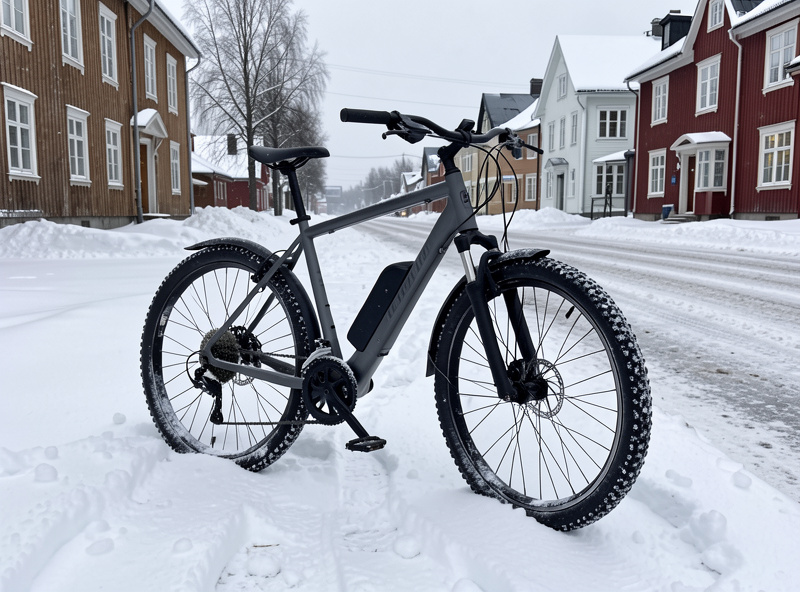
My winter rhythm: clean and re-lube the drivetrain more often (wet lube, applied after rides, not before), keep the battery contacts clean and dry, wipe salt off after slushy commutes, and run studded tires that I check for pressure weekly because a heavy bike pinch-flats hard. Cold also shrinks range — that’s a battery-chemistry reality, not a fault — which I document in my cold weather range loss log. The full season-by-season checklist lives in the seasonal service schedule. A weatherproof chain wear gauge in the toolbox is the single cheapest tool that saves you the most money over a winter.
Tires: The Cheap Part That Carries the Whole Bike
Tire pressure is the most under-rated maintenance job on an e-bike, and it’s the one I check weekly without fail. A heavier bike loads its tires harder, so an under-inflated e-bike tire pinch-flats where a lighter bike would have shrugged it off, and it bleeds range through extra rolling resistance the whole time. On my test loop I’ve measured the Wh/km penalty of a soft tire, and it’s not trivial — it’s measurable assist you’re paying for at the wall.
Run the pressure the tire sidewall recommends for your loaded weight, and remember that an e-bike is almost always ridden loaded: you, a pannier, a lock, the motor and battery. I run mine toward the firmer end of the printed range for commuting and drop a little for grip on winter ice. Inspect the tread and sidewalls at the same time — e-bike torque scrubs the rear tire faster than the front, so they wear unevenly and rotating or replacing in pairs keeps handling predictable. A puncture-resistant commuter tire is one of the few upgrades that pays for itself in flats you don’t get, and it’s worth fitting a quality puncture-resistant e-bike tire over the cheapest option. Pressure discipline is free; the only cost is remembering to do it.
The Toolkit That Covers 90% of the Jobs
You don’t need a pro workshop to keep an e-bike healthy — you need about six items and the habit of using them. The core kit: a chain wear gauge, a set of hex keys and a small torque wrench, a chain-cleaning tool or brush, degreaser and a good wet/dry lube, a track pump with a gauge, and a spare set of brake pads. That covers the chain, brakes, drivetrain cleaning, and tire pressure — the four jobs you’ll do most often.
The torque wrench is the one people skip and shouldn’t. E-bike components — especially around the motor mount, stem, and disc-rotor bolts — have real torque specs, and the extra vibration and load of a powered bike works under-tightened bolts loose and over-tightened ones to failure. I keep the gauge and the torque wrench where I’ll actually reach for them, because a tool in a drawer you never open does nothing. The whole kit costs less than one drivetrain replacement, and it pays for itself the first time you catch a stretched chain before it eats the cassette. Everything past that — bleed kits, truing stands, bearing presses — is shop territory until you’re sure you’ll use it.
What You Can DIY and What’s Worth the Shop
Most of the high-frequency jobs are firmly DIY: chain checks, lubing, pad swaps, tire pressure, cleaning, and spoke-tension feeling. They need cheap tools and twenty minutes, and doing them yourself is how you catch problems early. The shop earns its money on the lower-frequency, higher-stakes jobs: hydraulic brake bleeds, bottom-bracket and motor-mount torque, wheel re-tensioning and truing, and anything that needs the dealer’s diagnostic system to read the motor and BMS.
My rule of thumb: if the job is about watching wear, do it yourself — nobody checks your bike as often as you do. If the job is about specialist tools or torque specs that, done wrong, fail at speed, pay the shop. The brake bleed is the clearest example: I can do it, but a botched bleed on a bike that does 45 km/h is not where I want to learn. Decide which system you’re running before you buy, too — the maintenance load is part of the purchase, which is why I fold it into my commuting buyer’s advice and weigh it against the sensor type that shapes how the drivetrain gets used. Get the routine right and an e-bike is no more demanding than any other bike — it just punishes neglect a little faster.
Frequently Asked Questions
How often should I replace an e-bike chain?
Check chain wear with a gauge every 500 km and replace once it passes 0.75% elongation. On a mid-drive that often means every 1,500 to 2,500 km, because motor torque stretches chains faster than on an unpowered bike. Replace on time and one cassette outlasts three or four chains.
Why do e-bike brake pads wear out so fast?
E-bikes are heavier and often faster, so the brakes do more work to stop the same speed. Pad life is roughly half what you would get on an analog bike. Inspect every 1,000 km and replace once the friction material drops under about 1.5 mm to avoid scoring the rotor.
Do hub motor e-bikes really need spoke tension checks?
Yes. A hub motor adds heavy mass at the wheel center and its torque reaction works spokes loose over time. A detensioned spoke pulls the wheel out of true and can lead to spoke or flange failure. Check tension by feel at every service or roughly every 1,500 km.
Can I do most e-bike maintenance myself?
Most high-frequency jobs are DIY: chain checks, lubing, brake pad swaps, tire pressure, cleaning, and feeling spoke tension. Leave hydraulic brake bleeds, motor-mount torque, wheel re-tensioning, and motor or BMS diagnostics to a shop with the dealer system and correct tools.
Does an e-bike motor itself need maintenance?
The motor unit is largely sealed and maintenance-free. What needs attention is everything around it: the chain and cassette it drives, the bottom bracket and mounting bolts on a mid-drive, the spokes on a hub motor, and clean, dry electrical contacts. An annual dealer diagnostic catches sensor and BMS faults early.
How does winter change e-bike maintenance?
Salt and grit accelerate drivetrain wear and corrode contacts, so clean and re-lube more often with a wet lube applied after rides. Wipe salt off, keep battery contacts dry, and check tire pressure weekly because a heavy bike pinch-flats hard. Cold also shrinks range, which is normal battery behavior, not a fault.