Important Disclaimer
eBikeGarageHQ provides educational content and estimates only. We are not certified installers, financial advisors, or electricians. Always consult with licensed professionals.
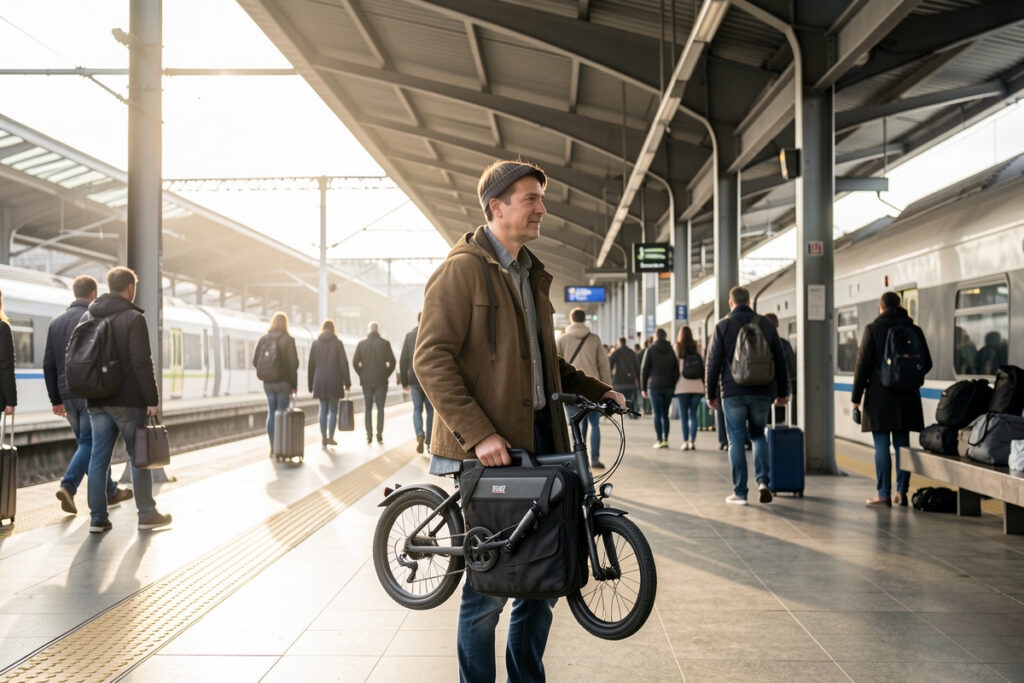
A folding e-bike works for train commuting because it folds to roughly 80 x 65 x 40 cm in 10 to 20 seconds and travels as free hand luggage on most rail networks, where a full-size bike needs a reservation, a bike carriage and often a fee. The bike that succeeds at this is judged on four things: fold footprint, fold speed, carry weight, and whether it stays folded in a crowded carriage.
I commute this way through Swedish seasons — ride to the station, fold, board, ride the last mile — and the bike that makes it painless is not the one with the best range or the cheapest price. It is the one that folds small, latches in one motion, and weighs little enough to hold one-handed while the other hand finds a pole. This is the requirements list I wish someone had handed me before my first folder.
Why a Folder Beats a Full-Size Bike on the Train
Folded, an e-bike counts as hand luggage on most networks and rides free, any time of day; a full-size e-bike usually needs a bike space that books out, costs extra, and disappears at rush hour. That single rule is the entire reason the folding format exists for rail commuters. A 20 kg folded package you carry aboard beats a 25 kg bike you are not allowed to bring.
The practical effect is freedom from the timetable. I have watched riders with full-size bikes turned away from a packed regional train because the two bike hooks were taken, while I walked on with a folded bike under one arm and nobody blinked. If a train sits in the middle of your commute, the folder is not a compromise — it is the only format that reliably works. The trade-offs it asks for in return (ride feel, range) are covered in the folding e-bike guide.
The Four Specs That Actually Matter for Rail
For train use, rank folders on fold footprint, fold time, carry weight and fold security — in that order, ahead of range or motor. A 17 kg folder that packs to a tidy parcel and latches shut beats a 22 kg folder with double the battery every single time you are standing in a vestibule. The station environment, not the open road, sets the requirements here.
Fold footprint decides whether you fit in the luggage rack or the door well without blocking it. Fold time decides whether you are the calm person who folded before the train arrived or the flustered one wrestling a hinge as the doors close. Carry weight decides whether you can lift it over a gap or up to an overhead-ish shelf. And fold security — a latch or strap that keeps the bike a single rigid object — decides whether a pedal swings into a stranger’s shin on a corner. Get those four right and the bike disappears into your journey. The honest carry-weight reality, which is where most buyers guess wrong, gets its own deep look in the main folding guide; here, treat anything over 22 kg as a daily strain.
Carry Weight Is the Spec You’ll Curse or Bless
Weight matters more on a train commute than anywhere else because you carry the bike at both ends and sometimes through it. Aim for under 18 kg if stairs or gaps are part of your route; 18 to 20 kg is manageable; above 22 kg you will resent it by the end of the week. Lighter almost always means a smaller battery, which is a fair trade for a short last mile.
Here is the maths I actually do. A train commute rarely needs huge range — the bike covers two short hops, not a 40 km slog — so a 300 to 400 Wh battery is plenty, and that smaller pack is exactly what keeps the bike light enough to carry. Buying a heavy, big-battery folder for a rail commute is paying carry-weight for range you will never use. I budget range from Wh the same way across every bike I own; the method is in range anxiety vs range math and the broader range guide, and cold mornings take their cut too — my winter range log shows how much.
Fold Discipline on a Crowded Carriage
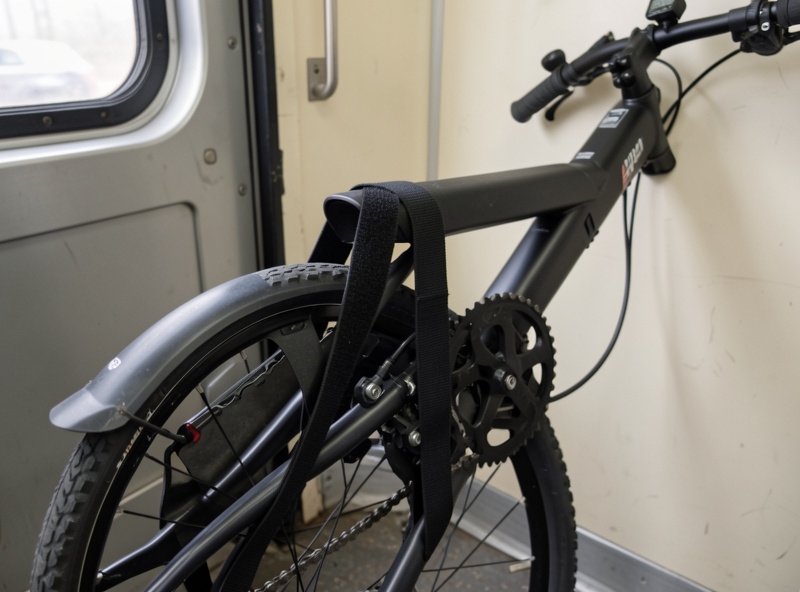
The unwritten rule of train cycling is that your folded bike must behave like luggage, not a bike: rigid, clean, and out of the aisle. Fold before you board, latch every catch, and stand the bike where its wheels and pedals cannot snag a passing leg. One swinging pedal or a chain-mark on someone’s coat is how rail operators end up banning bikes altogether.
I keep a simple routine. Fold on the platform, not in the doorway. Loop a Velcro frame strap so the halves cannot drift apart. Park the bike with the dirty drivetrain facing the wall, not the walkway. And on a busy service I keep a hand on it — a folded bike is a tripping object the moment the train lurches. Protecting the drivetrain matters too: a folded bike rests on parts that pick up grime, and the wear rhythm I run is in the maintenance guide. Treat your folding manners as the thing that keeps the privilege alive for everyone.
The Last Mile and the Loadout
The point of the folder is the last mile at the far end, so set the bike up for a quick unfold and a short, practical ride: clamp-on lights you never remove, mudguards for wet platforms, and a small front bag rather than panniers that fight the fold. A folder is a tool for the gap between the station and the door, not a touring rig.
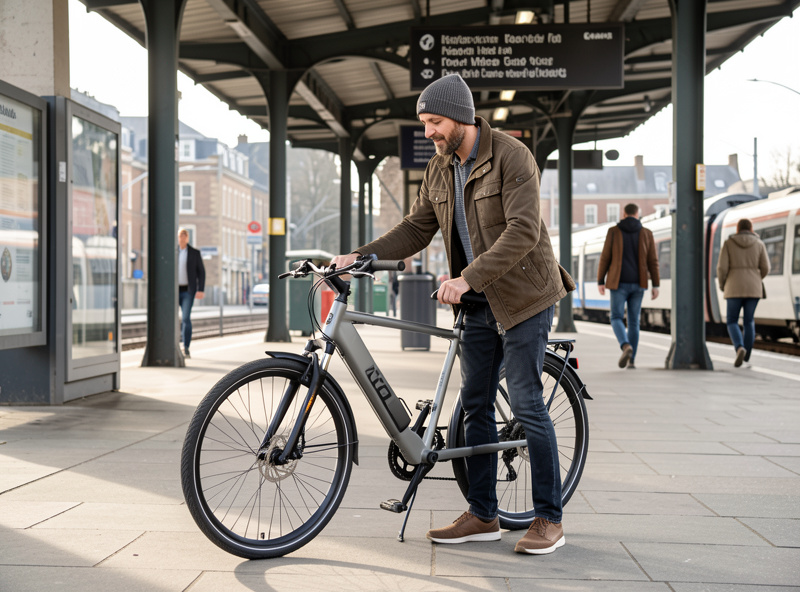
My four-season folder loadout is deliberately minimal. Good rechargeable lights stay clamped through every fold — the set I trust is in the winter lights guide. Compact fenders keep station spray off your work clothes; the fenders and racks guide covers what fits a small frame. If you ever lock it outside the station rather than carrying it in, the two-lock strategy still applies, though the real security move with a folder is taking it with you.
As an Amazon Associate I earn from qualifying purchases. The two accessories that earn their place on a rail folder are a padded shoulder carry strap and a clamp-on rechargeable light set you leave on through every fold.
Legal Note for Rail Commuters
Confirm two things before you commit: that your folder is road-legal in your region, and that your specific rail operator carries folded bikes. In the EU and UK that means a pedal-assist, 250 W, 25 km/h folder; in the US, a Class 1, 2 or 3 machine. Most operators carry folded bikes free, but the fold-size limit and any peak-hour rules are theirs to set.
I ride under the EU 250 W / 25 km/h frame and would never claim a throttle folder is legal where it is not — a wrong legal claim is a real harm, not a detail. Check your operator’s printed conditions for a folded-dimensions limit (some specify a maximum packed size), and if you have converted a bike yourself, read the EU conversion legality guide before you trust it on a platform.
Frequently Asked Questions
Can you take a folding e-bike on a train for free?
On most rail networks, yes. A folded bike counts as hand luggage and travels free, any time of day, where a full-size bike needs a paid reservation and a bike space. Confirm your specific operator’s rules, including any maximum folded-size limit, before you rely on it for a daily commute.
How heavy should a train-commute folding e-bike be?
Aim for under 18 kg if your route includes stairs or platform gaps, and treat 22 kg as the upper limit before it becomes a daily strain. A train commute needs little range, so a lighter folder with a 300 to 400 Wh battery is the right trade. You carry the bike at both ends, so weight beats range here.
How fast does a folding e-bike need to fold for commuting?
A good commuter folder collapses in 10 to 20 seconds with practice. Fold speed matters because you fold on the platform before the train arrives, not in the doorway as doors close. Prioritise a fold that latches in one confident motion over one that packs a few centimetres smaller but fiddles.
What size does a folding e-bike pack down to for the train?
A typical 20-inch commuter folder packs to roughly 80 x 65 x 40 cm. That fits a luggage rack or a door well without blocking the aisle. Some operators set a maximum folded dimension, so check the printed conditions, and always use a frame strap so the package stays rigid like luggage.
Is a small battery a problem for a train commute?
No. A rail commute is usually two short hops, so a 300 to 400 Wh battery covers it easily while keeping the bike light enough to carry. Budget your range from Wh: at 12 to 18 Wh per km, even a small pack handles a typical last mile twice over, with margin for a cold morning.