Important Disclaimer
eBikeGarageHQ provides educational content and estimates only. We are not certified installers, financial advisors, or electricians. Always consult with licensed professionals.
Store an e-bike battery at roughly 40-60% charge, somewhere cool, dry, and indoors, and top it back into that window every couple of months. A half-charged pack in a stable room ages very slowly; one abandoned full or empty over a long winter loses capacity it never recovers.
I live in Sweden, so winter storage is not a hypothetical for me, it is a yearly ritual on both my e-bike packs and the cells on my stationary battery bench. The chemistry is identical, and so is the routine: get the charge to the middle of the range, find a stable indoor spot, set a reminder, and otherwise leave it alone. Here is exactly how and why.
What Charge Level Should I Store It At?
Aim for 40-60% state of charge for storage longer than a couple of weeks. This middle band keeps the cells at a relaxed voltage, away from both the high-voltage stress of a full pack and the deep-discharge risk of an empty one. If your bike shows percentage, charge or discharge to roughly half and stop there; if it only shows bars, half the bars is close enough.
The reason the middle matters is that lithium-ion cells age fastest at the extremes and slowest in the middle. A pack stored at 100% for four months can lose a meaningful chunk of capacity to calendar aging, and a pack stored near empty risks self-discharging below the safe floor over months and becoming unrecoverable. Half charge dodges both failure modes with room to spare, which is why it is the standard recommendation across battery manufacturers and the habit I follow without exception.
If your bike has a charge-limit feature, it makes hitting the storage window trivial: ride or charge until the pack reads around half, then stop. If it does not, you can ride the battery down to roughly half on a final autumn outing, or part-charge an empty one and watch the display until it reaches the middle. There is no need to be surgical about it; anywhere from 40 to 60% is fine, and the pack does not care whether you arrive there by charging up or running down. The aim is just to avoid leaving it parked at either end for the months ahead.
Where Should I Keep the Battery Over Winter?
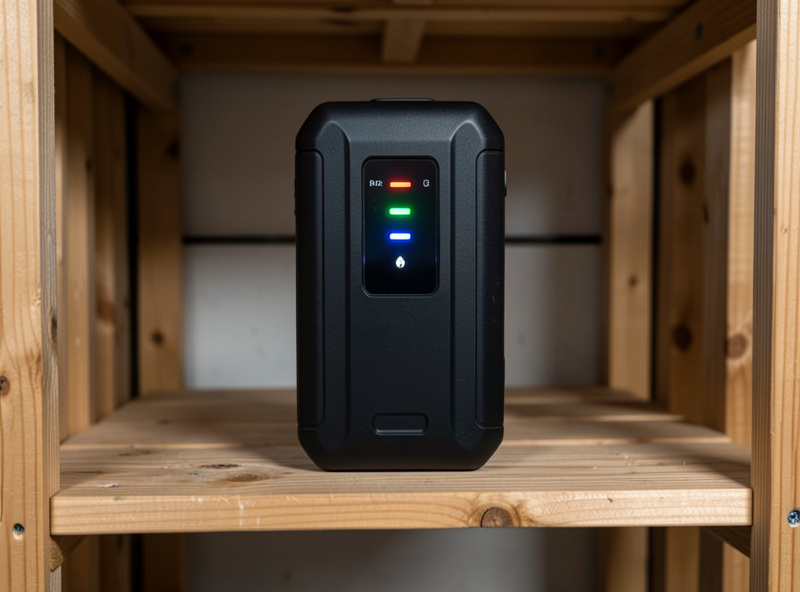
Keep it indoors at a stable, cool room temperature, ideally somewhere between about 10 and 20 degrees C, dry, and out of direct sunlight. A heated garage shelf, a hallway cupboard, or a basement that does not freeze all work. What you want to avoid is an unheated shed or balcony where the pack swings below freezing for weeks, and equally a hot spot near a radiator or in summer sun.
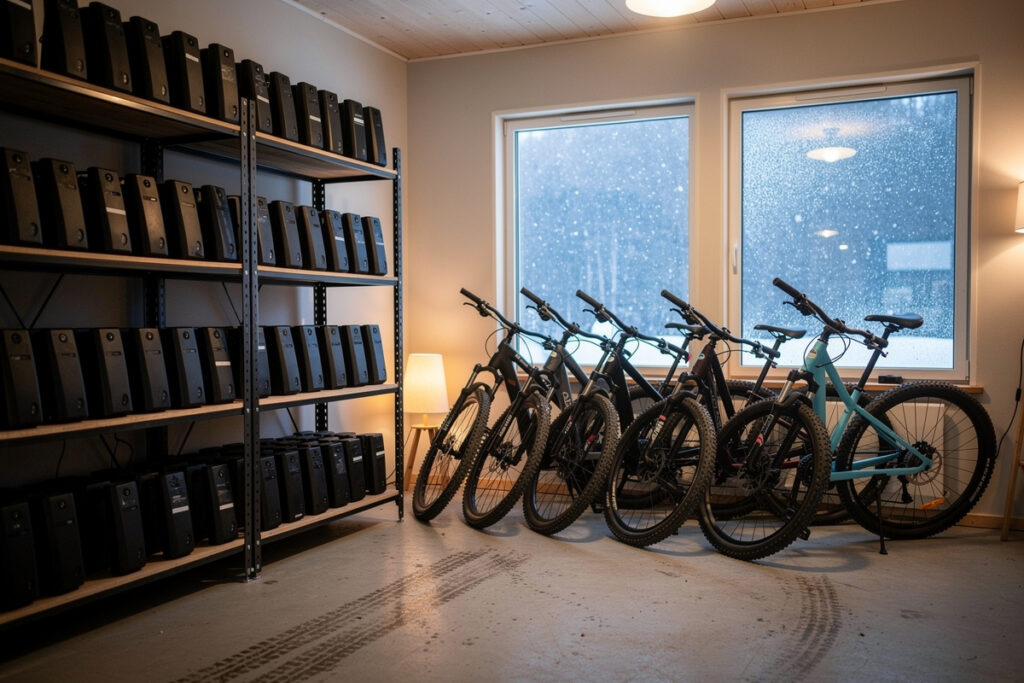
This is the part Nordic riders get wrong most often: leaving the battery clipped to a bike parked in an unheated garage all winter. The cold itself does not destroy a stored battery quickly, but it makes it impossible to charge safely without warming first, and freeze-thaw cycles are not doing the cells any favors. I pull both my packs off the bikes in November and they live on a shelf in the heated end of the garage until spring. The bikes can sit in the cold; the batteries come inside.
Do I Need to Top It Up During Storage?
Yes, check it every two months or so and top it back into the 40-60% window if it has drifted low. All lithium-ion packs self-discharge slowly even when switched off, typically losing a few percent a month, and a BMS draws a tiny standby current of its own. Over a five-month winter that adds up enough to matter.
The failure I have seen strand people is the pack stored near empty in autumn, forgotten, and found dead in spring, drained below the level the BMS will let you recharge from. A pack stored at half charge has months of buffer before it gets near that floor, but I still set a calendar reminder for every eight weeks. When it pings, I glance at the indicator lights, give it a short top-up if needed, and put it back. Two minutes, twice a winter.
One detail worth knowing: a pack that has been left to drain very low is sometimes recoverable and sometimes not, and the safe answer is not to gamble on it. If a battery has gone completely flat in storage and will not start charging from its normal charger, do not try to coax it back with anything improvised. Contact the manufacturer or a qualified shop. A deeply over-discharged lithium pack can be genuinely hazardous to revive, which is exactly why the half-charge habit and the eight-week check exist in the first place: they keep you well away from that edge.
Storage Conditions: Good vs Bad
The whole protocol fits in a short checklist, and the failures are just the inverse of the good practice. Get these five right and the pack sails through winter:
- Charge level: store at 40-60%, not at 100% and not near 0%.
- Temperature: cool and stable, roughly 10-20 degrees C indoors, never a freezing shed or a hot sunny spot.
- Humidity: dry, not a damp basement or outdoors.
- Check interval: top up every couple of months rather than forgetting it until spring.
- Location: off the bike on a shelf, not clipped to a bike sitting in the cold.
Should I Take the Battery Off the Bike?
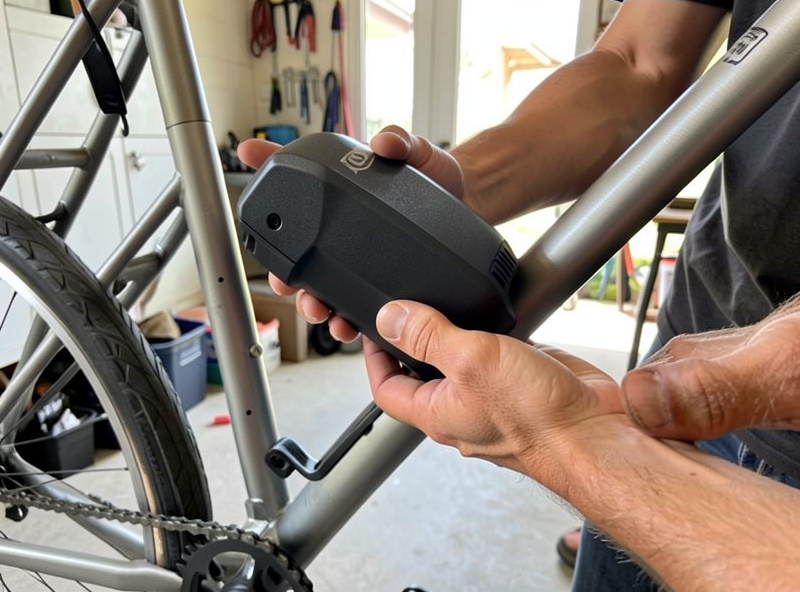
For long storage, yes, take it off. A removable pack belongs on an indoor shelf where you control the temperature, not clipped to a bike that is sitting in the cold. Removing it also means the bike’s electronics are not drawing any standby current, and it lets you store the battery somewhere you will actually remember to check it.
If your e-bike has an integrated, non-removable battery, you cannot do this, so the next best thing is to store the whole bike somewhere that does not freeze and to charge it to the storage window before it goes away. The same indoor, cool, dry rules apply; you just have to move the bike rather than the pack. Either way the principle holds: the cells want a stable, moderate temperature, and you arrange the storage around that. On a removable system, separating the pack from the bike is simply the easiest way to give it one.
Getting It Ready to Ride Again in Spring
When riding season returns, bring the pack to room temperature before charging, then charge it up and ride. Never charge a battery straight out of a cold space; if it has been somewhere chilly, let it warm to room temperature first, because charging a near-freezing pack can cause permanent internal damage. Warm first, charge second, ride third.
Do not expect a “reconditioning” ritual, there is none to do. A properly stored lithium pack does not need a deep discharge or a calibration cycle to wake up; that is old nickel-battery folklore. Charge it, take a gentle first ride to confirm everything feels normal, and if the range seems oddly low even when warm and full, that is worth investigating as genuine capacity fade rather than a storage hangover. Cold-weather range loss while riding is normal and temporary, which I cover in detail in my guide to cold weather e-bike range loss.
What Storage Does Not Require
Storage care is about conditions, not intervention, and that is worth stating plainly because the internet is full of risky “winterizing” advice. You do not open the pack, you do not remove cells, you do not bypass the BMS, and you do not modify the charger to hold a partial charge. Every one of those crosses from care into the kind of pack-level work that is a genuine fire risk, and none of it is necessary.
The entire job is: half charge, cool dry indoor spot, off the bike, top up every couple of months, warm before charging in spring. That is the whole protocol, and it sits inside the broader set of habits in my e-bike battery care guide. Get storage right and you protect the most vulnerable months of the battery’s year with almost no effort.
Frequently Asked Questions
What percentage should I store my e-bike battery at over winter?
Store it at about 40-60% charge. This middle band avoids both the high-voltage stress of a full pack and the deep-discharge risk of an empty one, which are the two states that age lithium-ion cells fastest during long storage.
Can I leave my e-bike battery in a cold garage all winter?
It is better to bring it indoors. Cold does not destroy a stored pack quickly, but it makes safe charging impossible without warming first, and freeze-thaw cycles add stress. Keep the battery on an indoor shelf and let the bike sit in the cold instead.
How often should I check a stored e-bike battery?
Every two months or so. Lithium packs self-discharge a few percent a month plus a small BMS standby draw, so over a long winter the charge drifts down. Check the level and top it back into the 40-60% window if needed.
Will storing it fully charged ruin my battery?
Not in one season, but a pack held at 100% for months loses more capacity to calendar aging than one stored at half charge. It will not die, it will just age faster. Half charge is the gentler, standard recommendation.
Do I need to do anything special before riding in spring?
Just warm the pack to room temperature before charging, then charge and ride. There is no reconditioning or calibration cycle to perform; that is old nickel-battery advice. A gentle first ride confirms everything feels normal.
Keep the Pack Healthy
- E-Bike Battery Care: The Complete Habit Guide
- Charge to 80 or 100? The Daily Charging Answer
- Cold Weather E-Bike Range Loss Explained
More from This Cluster
- “E-Bike Charging Cost: The Wall-Outlet Math”
- “Charging Habits That Extend E-Bike Battery Life”
- “E-Bike Battery Lifespan: How Many Years to Expect”
- “Is a Second E-Bike Battery Worth It? An Honest Take”
- “Charge Your E-Bike Battery to 80 or 100? The Honest Answer”
- “E-Bike Battery Care: The Habits That Make a Pack Last”