Important Disclaimer
eBikeGarageHQ provides educational content and estimates only. We are not certified installers, financial advisors, or electricians. Always consult with licensed professionals.
An e-bike range calculator only works if you feed it real numbers. The honest formula is simple: usable battery energy (about 90% of rated watt-hours) divided by your measured Wh/km equals your range in kilometres. A 500 Wh pack at 12 Wh/km gives roughly 37 km — not the 80 km a brochure might promise. Everything else is just measuring those two inputs accurately.
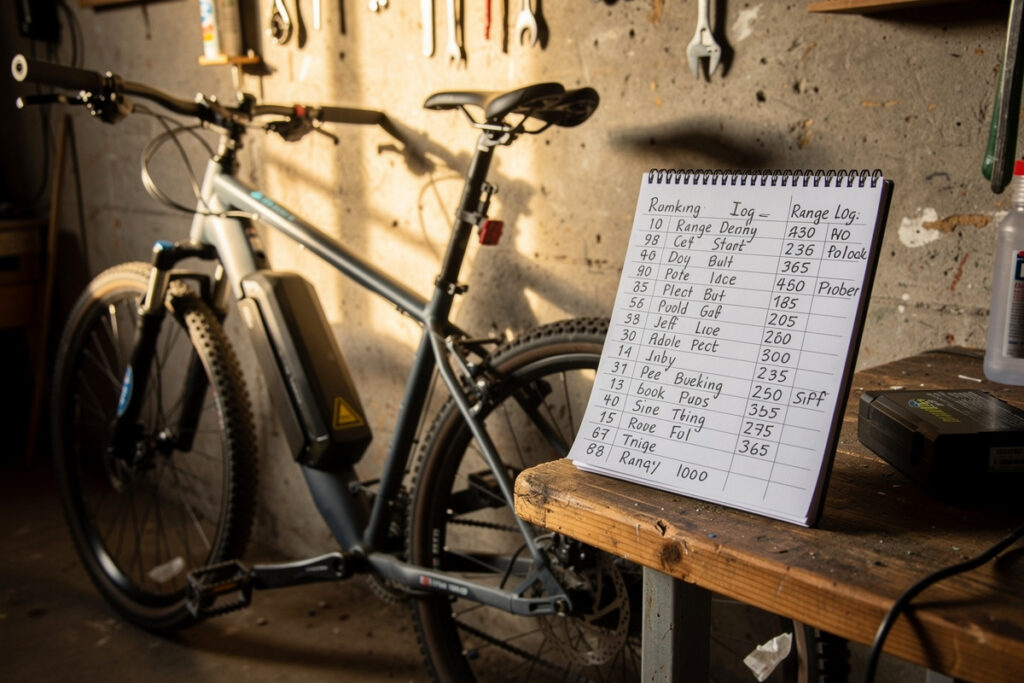
I’ve spent years logging range on a repeatable loop instead of trusting spec sheets, and the calculators that fail are the ones that ask for a battery size and spit out a single optimistic figure. The ones that work make you confront the four variables that actually move consumption. This guide is the method I use to turn those variables into a number I’d bet a commute on, and it’s the practical engine behind the broader e-bike range guide.
The Only Formula That Matters
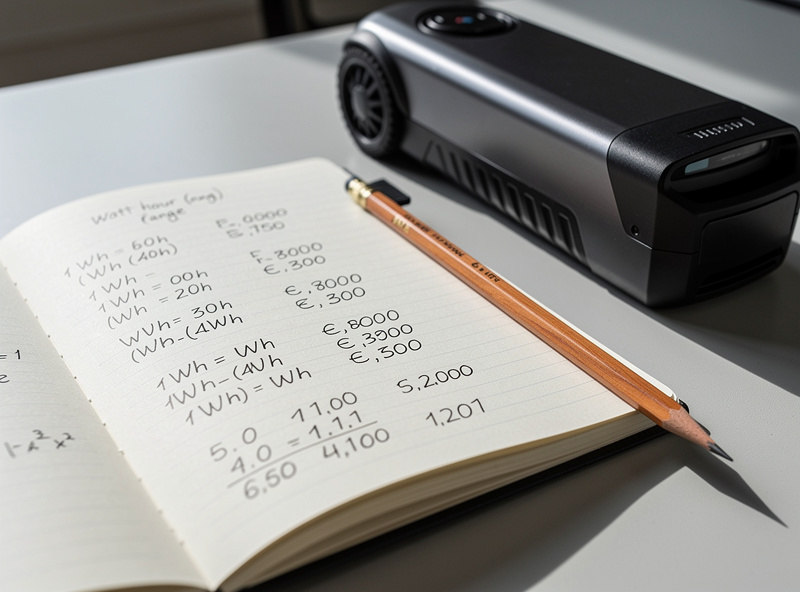
Range = usable Wh ÷ Wh/km. That’s it. Usable Wh is roughly 90% of your battery’s rated capacity, because discharging a lithium pack stone-dead is hard on it and gains almost nothing. Wh/km is how much energy you actually burn per kilometre — the number nobody prints because it depends entirely on how and where you ride.
Take a 625 Wh battery: usable energy is about 562 Wh. On an easy flat commute at ~8 Wh/km that’s ~70 km. On a hilly route at high assist burning ~18 Wh/km it’s ~31 km. Same battery, less than half the range. A calculator that doesn’t let you set the Wh/km is lying to you by omission. Once you accept that the consumption figure is the whole game, range stops being a mystery and becomes arithmetic you can do at the kitchen table before you leave.
The Four Inputs You Must Estimate
A real calculator needs four honest inputs, because together they set your Wh/km. Guess them well and the output is trustworthy; default them all to "ideal" and you get the brochure fiction back.
- Terrain — flat, rolling, or genuinely hilly. Climbing is the single biggest energy cost, so total elevation gain matters more than distance.
- Assist level — the share of work the motor adds. Top assist can burn double the Wh/km of a middle setting on the same road.
- Temperature — a cold pack delivers less usable energy and you push through denser air.
- Rider and load — your weight plus cargo, tyre pressure, and how hard you yourself pedal. A fit rider on hard tyres burns far less than a heavy load on soft ones.
Wind belongs in here too, as a temporary terrain penalty: a sustained headwind behaves like a hill that never crests. When I plan an exposed coastal ride, I bump my Wh/km estimate up a column purely for the wind.
Starter Wh/km Numbers From My Log
If you haven’t measured your own consumption yet, these are honest starting figures from my own logged rides — use them until you’ve recorded a loop of your own. They assume real pedal-assist riding, not throttle-only.
| Scenario | Typical Wh/km | Range on 450 Wh usable |
|---|---|---|
| Flat, low assist, fit rider, hard tyres | ~7–8 Wh/km | ~56–64 km |
| Mixed rolling, medium assist (typical commute) | ~11–13 Wh/km | ~35–41 km |
| Hilly route or high assist | ~16–19 Wh/km | ~24–28 km |
| Cold winter + headwind | ~20–24 Wh/km | ~19–23 km |
| Heavy cargo load, hills, high assist | ~22–28 Wh/km | ~16–20 km |
The point of a personal table is that it replaces every assumption with a measurement. Terrain alone shifts these figures more than anything else, which is why I treat elevation gain as a first-class input rather than an afterthought — the broader range guide lays out the full planning grid these numbers feed into.
A Worked Example
Say my commute is 22 km each way, mixed rolling terrain, ridden at medium assist on a 500 Wh bike. Usable energy is ~450 Wh. My logged Wh/km for that profile is about 12, so my one-way consumption is 22 × 12 = 264 Wh, and the round trip is 528 Wh — more than my usable 450. The calculator just told me, before I left home, that I cannot do the round trip on one charge at medium assist.
The fixes are now obvious and quantified: drop to low assist on the flat stretches to pull Wh/km down toward 9 (44 km round trip lands near 396 Wh — comfortable), or charge at work, or carry a second battery. That’s the entire value of calculating instead of hoping: you find the problem in the kitchen, not stranded 4 km from home with a dead pack.
How to Measure Your Own Wh/km
The calculator is only as good as your Wh/km input, so measure it once and you’re set for that bike. Charge to full, ride a fixed loop the way you normally would, and at the end read the watt-hours used from your display if it shows them. Divide by the kilometres ridden. If your display only shows percentage, note the percentage drop and multiply by usable Wh: a 40% drop on a 450 Wh usable pack is ~180 Wh.
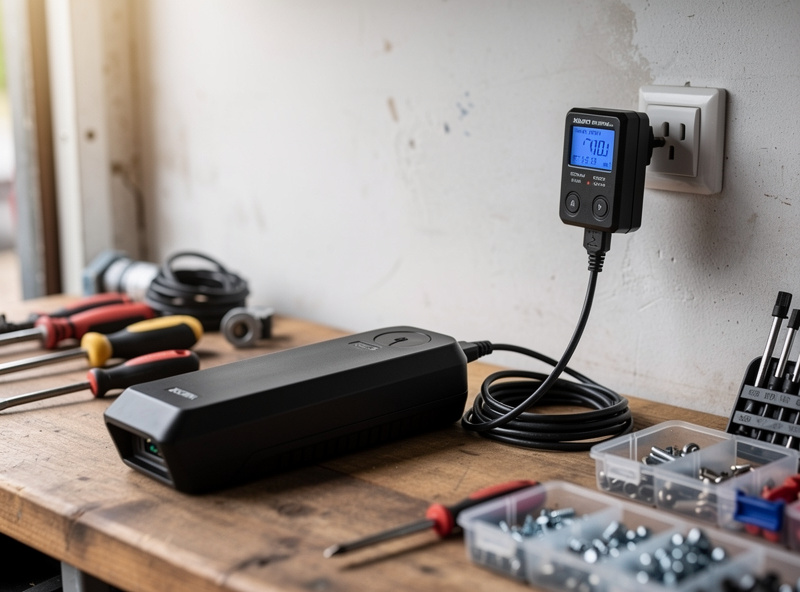
For the most honest number, log the charge at the wall with a cheap plug-in energy/watt-meter — it shows exactly how much energy went back in, which over time reveals your true usable capacity as the pack ages. This is the same watt-meter discipline I bring from my stationary battery bench; Wh doesn’t care whether it’s spinning a wheel or backing up a house.
As an Amazon Associate I earn from qualifying purchases. Links to gear are search links; I never quote a price next to them.
An EU/US Note on Speed and Range
Your legal class quietly shapes the calculator, because it caps assisted speed and speed drives Wh/km hard. In the EU, a standard pedelec assists up to 25 km/h on a 250 W rated motor; hold that and your consumption stays modest. In the US, a Class 3 bike will assist to 28 mph (~45 km/h), and holding that higher speed burns substantially more Wh/km because aerodynamic drag rises steeply with pace.
So if you ride a faster class and habitually pin it at the assist cut-off, budget a higher Wh/km than a rider on an EU-limited pedelec doing the same distance. It’s not a fault in either system — just physics. Confirm your local rules; this is how the classes are defined, not legal advice.
Further Reading
- E-Bike Range Guide — the full range cluster, the planning grid, and how every variable fits together.
Frequently Asked Questions
How do I calculate e-bike range?
Divide usable battery energy (about 90 percent of rated watt-hours) by your Wh per km. A 450 Wh usable pack at 12 Wh per km gives about 37 km. The accuracy depends entirely on using your real Wh per km, not a default.
What is a realistic Wh per km for an e-bike?
A flat low-assist commute runs about 7 to 8 Wh per km, a typical mixed commute about 11 to 13, and hills or high assist about 16 to 19. Cold and headwind can push it past 22 Wh per km.
Why is the calculated range different from the advertised range?
Advertised range assumes ideal conditions: light rider, flat ground, lowest assist, mild weather. A calculator using your real terrain, assist and temperature returns a far lower and more honest number for everyday riding.
How do I find my Wh per km?
Charge to full, ride a fixed loop normally, then divide the watt-hours used (from your display or measured at the wall) by the kilometres ridden. Log it with the temperature and assist level for a personal reference table.
Does riding faster reduce e-bike range?
Yes. Aerodynamic drag rises steeply with speed, so holding a higher assisted speed burns more Wh per km. An EU pedelec capped at 25 km/h is more frugal than a US Class 3 bike held at 28 mph over the same distance.
More from This Cluster
- “Manufacturer E-Bike Range Claims
- “E-Bike Range Anxiety vs Range Math: Trusting the Numbers”
- “E-Bike Assist Level and Battery Use: Where the Wh Go”
- “Cold Weather E-Bike Range Loss: What a Winter Log Shows”
- “E-Bike Wh per km by Terrain: A Field-Logged Energy Budget”
- “E-Bike Range Guide: How Far You Actually Go on a Charge”